Showing posts with label evolution. Show all posts

Sunday, June 21, 2009

sword-billed hummingbird


Art
Probably not much today studying for the Comptia Network +

Animal

The sword-billed hummingbird (Ensifera ensifera) is a South American hummingbird with the longest bill to body proportion among birds. It specializes in flowers with long corollas such as Datura, passionflowers and fuchsias. These hummingbirds are a very extreme example of coevolution between pollinators and the plants they pollinate. It's bill is so large that it can not be used in groom so the bird grooms with it's feet. It must hold it's bill at a certain angle to fly and perch. They are also among the largest hummingbirds at 12 grams.

Friday, May 8, 2009

Iberomesornis romerali

Today was sort of mind numbing at work. It should be slowing down with finals wrapping up. Maybe I will try to get out of the house tonight. Stuart and I got into a strangely long conversation about clove cigarette smell last night. I do have kind of a weird story regarding that. I was walking to the ceramics lab  during the period when I was getting my BA and it was way out in the middle of no-where in some metal shacks near the agriculture departments test fields and livestock. It was just dark and there was no breeze and I was on a road between a large empty field and a tiny cemetery. I hit this patch of clove cigarette smell on the middle of the road that was about ten feet in diameter and intensely strong like someone had smoked a whole pack of them. It was very concentrated to this one little spot. There was no one around and it really was not a good place to have done so no where to sit it was just in this big empty field no where near the entrance to the cemetery and not inside it at all. It was kind of a mystery did someone just stop in the middle of this road smoke multiple cloves then move on, stop smoke a bunch of cigarettes and drop a bottle of essential oil, invisible goth? I probably need better mysteries.

Art
still off

Animal

Iberomesornis romerali was an enantiornithine bird from the early Cretaceous that was found in Spain in 1985. It was about the size of a sparrow and while it retained a few unbirdlike characteristics like wing claws and teeth it was capable of true flight. Enantiornithine birds are also different from modern birds also in that their shoulder bones have a concave-convex configuration that is the inverse of modern birds.

Tuesday, April 21, 2009

Ajolote Lizard


 Art
Goal for the week 18hrs
Today
Work on the sphinx

Animal

The Ajolote Lizard (Bipes biporus) is a two legged Amphisbaenian (worm lizards sort of the odd group out in the snakes and lizards of Squamata). They are found in California and Mexico. This reptile spends most of it's time burrowing, often near mesquite shrubs using it's legs to do most of the digging. They will occasionally leave there burrows at night to hunt surface dwelling insects, but they tend to be awkward on the surface. They eat mostly ground dwelling invertebrates and they have fairly large teeth (Here is a skull). Their ears are unusual for Amphisbaenians in that they have extra folds of skin and fibrous tissue that may be related to what developed into the epihyal bone found in the ears of mammals according to Ernest Wever and Carl Gans. It seems that this ear set up also gives them better hearing then other Amphisbaenians.

Saturday, April 18, 2009

Channel Island Fox

Today we went out to the Boneyard Arts Festival in Urbana and ran into Andrew at some sort of weird (fake?) punk fashion show. He went to the other galleries with us. We also ran into one of my co-worker's mother who does wildlife photography. 

Art
Goal for the week 7.5 hrs
Today
I had not added an internal armature to the sphinx and I noticed its front legs were sinking in on themselves so I added one today.
work on sphinx

Animal 
Photo by the U.S National Park Service
The Channel Island fox (Urocyon littoralis) is dwarf fox related to gray foxes that lives only on the Channel Islands of California. They are the smallest foxes in North America at only around 4 lbs and standing 6 inches at the shoulder. They split off gray foxes after becoming isolated on the islands about 18000 years ago and have since become a separate species. Aside from their small size they are also different from gray foxes in that they have lost two vertebra. They are critically endangered for a variety of reasons. To begin several invasive species were introduced to the islands such as bison, cats, goats, and feral pigs. The bald eagles that had been on the island (and had not been preying on the foxes) died off due to problems with DDT and the golden eagle which had priorly not really inhabited the island was drawn in by the feral pigs and took the bald eagle's place. The golden eagle as a secondary prey item started preying on the foxes which were not well adjusted to having a regular predator around. Then the declining foxes which had been on an island mostly free of canine diseases picked up distemper from domestic dogs which wiped out quite a lot of them. Then in an effort to protect the endangered Loggerhead Shrike the US Navy was culling the foxes to keep them from preying on the birds, they stopped in 2000 as the foxes had become critically endangered as well. 

Friday, April 10, 2009

Elginia mirabilis

The cockroach living room is still outside my place of work though I notice people have been changing the position of the furniture. 

Art
goal for the week 14 hours
Today
work on the dragon


Animal 
drawing by Arthur Weasley photo by .:sandman

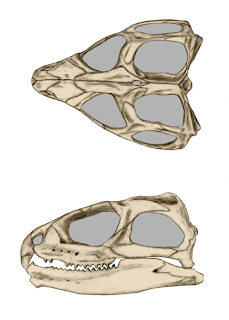
Elginia mirabilis was a small pareiasaur (about 2ft long) from Scotland during the Permian. Pareiasaurs are anapsid reptiles that may well be related to the things that became turtles. Turtles and anapsid reptiles have similar skull types and there is a debate as to whether turtles originated from this very early group or converged to having similar skull type. They have yet to find a lot of transitional turtle fossils aside from the 220 million year old Odontochelys. Elginia mirabilis was though to have been an herbivore and its impressive horns and bony plates were thought to be mostly for display. At the time Scotland likely would have been a desert so it might have been well adapted for dry conditions. It probably was not blue but how would you know.

Sunday, April 5, 2009

Black and Rufous Elephant Shrew

The party was a little quieter then I was expecting I hope people had a little bit of fun. Tomorrow we have a Funker vogt show in town. I'd kind of heard about it but I had assumed it would be in Chicago, hopefully there will be tickets at the door.

Art
sphinx

Animal

The black and rufous elephant shrew (Rhynchocyon petersi) is a relatively large sengi from Kenya and Tanzania. They are an odd group of mammals, elephant shrews are actually not related to shrews and are actually part of an ancient and once very diverse group of mammals that includes elephants, sea cows, aardvarks, hyraxes, golden moles, and tenrecs. They have a scent gland on their chest called a sternal gland that they use to scent mark their territory, sometimes as often as 5 times a minute. The males and females have a detectably different scents. They are monogamous and both the males and females will defend a territory but the pairs do not spend a lot of time together. Oh and they have a long flexible nose.

Friday, March 27, 2009

Marsupial mole

I've been listening to some of Rick and Kristen's radio shows online. Apparently they have been putting their Sunday WEFT shows up in a blog. Pretty much all goth and deathrock.

Art
Goal for the week 13.5 hours
Today 
work on the sphinx

Animal 

The southern marsupial mole (Notoryctes typhlops) is a very strange marsupial from southwest Australia. It is well adapted to swimming through the sand it has no external eyes or ears (they do have ear openings) and it's pouch faces backward to keep sand out of it. It is thought to eat mostly insects, lizards and seeds but very little is known about it's diet or behavior. It is only recently that that scientists were sure it was a marsupial rather then the link between marsupials and monotremes. It shares different characteristics with many of the living groups of marsupials making it difficult to place. Based on genetic evidence they have worked out that marsupial moles split off of  the main group of marsupials about 50 million years ago and have been evolving on a separate branch into something that very much resembles a golden mole. They are difficult to study as their tunnels collapse on themselves after they pass and they do very poorly in captivity. In captivity they spend a lot more time on the surface and tend to faint for hours at a time they tend not to survive more then a month in captive conditions. Some of the the Aborigines call them itjaritjari and they are associated to some extent with the creation of Uluru/Ayers Rock. They were also regarded with sympathy for their helplessness and only eaten durning very hard times. 

Monday, March 23, 2009

Rubber eel

I talked to my roommates and I think we will be still doing the April fools party thing for Loki this year. I might end up having to do it the weekend after the day to get more people though.
 
Art
Goal for the week 20hrs
Today
make clay
poke the guy with the Anubis mask access what needs to be done
work on the sphinx
look into how ventriloquist dummy heads are put together

Animal 
The rubber eel (Typhlonectes natans) is not a fish at all but is an amphibian from a group of amphibians called Caecilians. Caecilian are a somewhat poorly studied group as most members of the group live underground or are fully aquatic. In the case of the rubber eel, it is is fully aquatic. Rubber eels do much of their respiration through their skin, but also need to breath air.  Like other caecilians they have a second set of jaw muscles to help them keep their mouth closed while burrowing they also have a small tentacle between their eye and nostrils that acts as a chemical sensor. Their teeth are small and hook backward to help them grip their prey you can tell that they are advanced highly evolved caecilians as their mouth is below the center of their head. Earlier caecilians have a mouth that is centered at the terminal end of their head. Rubber eels give birth to live young and embryonic rubber eels have natal teeth that they use to bite the oviduct wall of their mother to cause them to secrete a nourishing substance. They seem to be not uncommon in captivity and I found quite a few care sheets while I was looking into them.

Thursday, March 19, 2009

Hesperonis regalis

I'm shifting schedules a little I think. I'm going to try to get a longer block of work in at night and sleep during the day.

Art
Goal for the week 14.5 hours
Today
make clay
work on the sphinx

Animal

Hesperonis regalis was a prehistoric flightless aquatic bird from the late Cretaceous it was found in the marine limestone from Kansas. It was found in the late 19th center and was an important early find in avian paleontology. It had teeth in it's beak which it used to hold down prey and lobed toes that acted like webbing. Early depictions showed them standing upright like penguins but it is unlikely that they could do that, they may not have been able to walk on land at all. It is thought that they got around on land by sliding on their belly it is also thought that they were migratory as more juveniles were found in northern sites.

Friday, March 13, 2009

Odobenocetops


Art
goal for the week 12.75 hrs
today
work on the guy with the Anubis mask

Animal
Odobenocetops (Odobenocetops peruvianus) was a relative of modern Narwhals and Beluga whales. This very early member of the dolphin superfamily was found off the coast of Peru about 4 million years ago. While it has a very walrus-like head this is an example of convergent evolution it is not actually related to walruses.  It has been suggested that it sucked bivalves out of their shells in a manner similar to a walrus. Like a walrus it had tusks it is thought that the tusk were either some sort of sensory organ or that they were part courtship process. The tusks on either side of it's head were uneven the right tusk being twice as long as the left. It is not uncommon for toothed whales to have asymmetrical skulls this being just a very extreme example. It is thought that asymmetrical skulls were part of the development of sonar. Odobenocetops peruvianus did not have sonar so far as paleontologists can tell it was probably not needed to catch bivalves. 

Sunday, March 8, 2009

Hallucigenia sparsa

I'm having to make all of this clay because I was really dumb and let my 6 year old Grolleg porcelain dry out. Sketches are done, made some porcelain, guess I'm really ready to get started. 

Art
goal for the week 6 hrs
Today
make more clay
Start making parts of the figure with the Anubis mask
get a little more modeling clay for the sphinx figure sculpt

Animal

Hallucigenia sparsa was a tiny (about 1 inch long) middle Cambrian invertebrate that was found in the Burgess Shale of British Columbia. I was discovered in 1979 by Conway Morris and dubbed Hallucigenia because it was so oddly put together. Morris depicted the animal as having a double row of spines that it walked on and a single row of feeding tentacles along its back. See the linked picture below. Critics pointed out to Morris that there were no known animals that walked on spines but Morris pointed out that he had found only a single row of tentacles on the animals back and these would not have made effective legs. In the late 1980's a dentist that had become a paleontologist named Lars Ramskold got permission from the curator of the Walcott Collection to excavate for a second set of tentacles to see if they could have acted as legs. This permission was very odd as this fossil was exceptionally rare and it was amazing that they would allow this sort of excavation which would damage it. Lars excavated and found the second set of legs, they then were able to flip the creature over and the little hooked tentacle legs were like other animals they had seen before in the line of ancestors of the velvet worms. Some of the ancestors of the velvet worms also had spines.


Saturday, March 7, 2009

Lettuce sea slug

We saw Watchmen last night it was truer to the comic then I had thought it would be. I finally have the compositions worked out for the fine art pieces. Now I just need to work out how the internal supports and channels for the wire are going to fit together. Unfortunately, all of my ideas this time were very complicated so I'm probably looking at 2 100+ hr pieces. So if I'm good I'm probably looking at June or July for those.

Art
goal for the week 11.75 hrs
today
do internal armature sketches
put slake on plaster, wedge, make more clay
Start the guy with the Anubis mask or work on wax dragon depending on clay availability


Animal  
The lettuce sea slug (Tridachia crispata) is a not uncommon sea slug from the Caribbean. They can range quite a bit in coloration from white to red to solid electric blue. They are herbivores but eat in an odd manner. They insert a fine tube into the plant and actually suck out the contents of the cells. They have been described as like a mosquito for algae. By removing the cell organelles from algae they can actually incorporate the chloroplasts into themselves and to some extent produce their own food from sunlight. They do also digest the other plant organelles that are not chloroplasts. They also produce a bad tasting compound from the organelles called chlorodesmin that helps to protect them from being eaten. They are sometimes kept in the aquarium hobby. They are said to control algae but don't really eat it at a high enough rate to be very effective at this.

Tuesday, March 3, 2009

Sunda flying lemur

Ok for the certifications I found out that I need to take the Network + 2009 by April 1st. I notice there is a lack of study materials for this test, fortunately the Comptia website had a package I could order. Shame about the deadline being on April 1st though I guess with it being in the middle of the week it would not have been ideal for a party.

Art
Goal for the week 17hrs
Today
still working out new fine art piece ideas
sanding

Animal
photo by Loochie

The Sunda flying lemur or Colugo (Galeopterus variegatus) is a gliding mammal from the order Dermoptera which inhabits south east Asia. While they are not primates and not particularly related to true lemurs, they are in the same branch of mammals as primates and tree shrews. Colugos are thought to be primates closest living relatives though they went in a fairly different direction specialising for gliding. As an order are the most capable of gliding mammals and can sustain a jump for up to 200 feet. It had been suggested that they may have represented a link between primates and bats, but genetic evidence has not supported this theory and bats have been placed in Pegasoferae with carnivores and odd toed ungulates. Flying lemurs are nocturnal heravores that raise their young in an almost marsupial-like manner. The young are born less developed and spend the first 6 months clinging to their mother's belly protected by skin folds. They breed very slowly and the young generally stay with their mother's for the first 2 or 3 years.

Saturday, February 21, 2009

Tuatara

Somewhat better today. 

Art
some sanding

Animal

Re-run from livejournal
The tuatara (Sphenodon punctatus) of New Zealand is not a lizard but one of the last surviving members of a mostly extinct group of reptiles the sphenodontians. They held the niche of lizards in the Mesozioc, but are completely unrelated to the lizards of Squamata today. Tuataras have a third eye with optic nerves in the center of their forehead that is visible when they are young and they have no external ears but can hear. Unlike all other living toothed reptiles they have an acrodont tooth structure which means that their teeth are fused to their jaw. They they have the slowest growth rate of the reptiles and a very slow rate of reproduction. Individuals can also live well over 100 years. For the Maori they are associated with Whiro the god of death and disaster. They are considered to indicate the borders between the mundane and the restricted sacred.

Here is a picture showing that third socket in the center of the skull

Tuesday, February 17, 2009

Stomatosuchus inermis

Art
Goal for the week 19.5hrs
today
sanding still

Animal
In the Middle Cretaceous in the swamps of northern Africa there was a crocodilian that became a filter feeder like a whale, Stomatosuchus inermis. It was over 40 feet long with a head that was around 6 feet long. It's upper jaw had hundreds of tiny teeth and it's lower jaw was toothless with a pelican like pouch. It is thought it would scoop water into it's throat pouch and then filter tiny invertebrates through it's teeth. It was thought to be almost fully aquatic returning to land only to lay eggs. Unfortunately very little study of this creature has been possible as the only known remains were destroyed in an allied bombing raid of the Munich Museum in 1944.

Thursday, February 5, 2009

Giant tropical penguin

I took Nick shopping last night. I guess he had run completely out of food and not told anyone. He should be well stocked now. 

Art 
goal for the week 17.25 hours
Today
still sanding
still need to work on new concepts no good ideas yesterday

Animal

Icadyptes salasi was a 5ft penguin from the late Eocene period found in Peru. It was not the largest of past giant penguins (some of the ancient penguins of Antarctica being larger) but it is known from the most complete remains. Oddly, it lived in a very warm climate on average the late Eocene was a very warm period and it lived near the equator. It had been priorly thought that penguins had evolved in around Antarctica and had moved into tropical areas only within the last few million years. This giant penguin was 30 million years too early so it seems penguins spread into more diverse climates earlier then priorly thought. It had a long spear-like beak similar to a heron's, but it is thought that feature was not particularly odd for early penguins.

Saturday, January 10, 2009

Tiktaalik

When I was given the duty of invoicing at my place of work they gave me a filing cabinet. In the filing cabinet there was an inexplicable pipe in the shape of a buffalo that seems to be a nice pipe made out of some specialty italian wood. I don't really smoke (smoking that would mix well with all the silica and plastic I breathe) so I just sat it on my desk for the novelty of a hornless buffalo pipe. I eventually gave it to another co worker who had it for about a year and then got laid off so it came back to me. I then gave it to Angel who intends to use it. He gave it back to me and asked me to add ceramic horns. I wonder if it will come back again.

Art
Goal for the week 15hrs
Today
sand boxes
work on dragon
finish casting crimson ghost for commission box (went with latex instead of silicone because it's cheaper and I only need a few)
sand commision box
paint commision box
make horns for the buffalo pipe for Angel

Animal

Tiktaalik (Tiktaalik roseae) is an extinct lobe-finned fish that existed around the Devonian in the area that became Canada. It is a transitional fossil between fish and tetrapods. Like fish it has fish-like scales and gills and like tetrapods it, also has lungs and a flexible neck. Like a tetrapod it's bone structure includes a shoulder, elbow and wrist bones, as well as musculature in the fins that would have been quite flexible. It likely could bear its weight with its fins. It was thought that the fish lived in shallow oxygen poor waters. It may have also occasionally pulled itself on to land in the manner of a lungfish. The name Tiktaalik came from an Inuit elders that suggested it since the fossils look like a local cod-like fish, a Burbot called a Tiktaalik in Inuit. Here is a shot of that fin/leg.

Sunday, January 4, 2009

Sharovipteryx

We did quite a bit of cleaning yesterday. I've started working on sanding the 214 new boxes and got a little work in on the dragon.

Art
Today
sand boxes
work on dragon

Animal
picture by Dmitry Bogdanov
In the early Triassic around the area of Kyrgyzstan there was a strange gliding reptile (Sharovipteryx mirabilis) that had it's main gliding membranes along it's back legs. It is thought by some that Sharovipteryx was bipedal and would launch into a glide from a running start, others think it was arboreal and launched itself from trees. It is the oldest know animal to have a gliding membrane attached to it's limbs and the only known animal to have it's primary gliding membrane on it's hind limbs. The species is known from only one fossil found in the Osh Region of Kyrgyzstan in 1971 which is a little crumbled in the front leading to some debate as to how membranes may have been attached in it's front area.

Monday, December 22, 2008

Demon Duck of Doom

I have to visit my relatives this week so it will not be an art week, but I'm hoping to still update the blog. Yesterday I got 212 wooden boxes for the eyeball boxes, so I have some serious sanding in my future.

art
Today
work on Dragon a little


Animal

The demon duck of doom (Bullockornis planei) was a giant flightless relative of waterfowl that once inhabited Australia. They were possibly the some of the heaviest birds that ever lived. Demon Ducks were around 2.5 meters tall and could weigh over 600 lbs. Given their impressive powerful beak and giant skull they were probably omnivores that ate things such as difficult to open fruit, nuts, and giant wombats. Their running speed may have been comparable to emus. Just thinking about the unpleasant attitude of large water fowl like geese and even more so swans, one has to wonder how terrifyingly aggressive these guys were. Could you imagine a 600lb animal that could easily rip your thigh off your body with the mentality of a Swan, stuff of nightmares.

Wednesday, December 17, 2008

Lesser Tree Shrew

Didn't get much done yesterday. I think I put the skull for the "misfits" box somewhere I would be able to find it later

Art Goal for the week 19 hrs
Today
-find the skull for the box that I had finished
-get approval and fix/or cast it if I can find it
-work on dragon

Animal


The lesser tree shrew (Tupaia minor) is native to Indonesia, Malaysia, and Thailand. Stuart and I were introduced to them recently at the National Zoo and thought that they were adorable. One of them was chasing this crested partridge about twice it's size. The bird did not seem terribly bothered by this, they kept it up for about 10 minutes. Despite being called tree shrews they are actually not related to shrews and are actually closer to prosimians. There is debate as the whether they belong in the same group as primates or with insectivores. They are omnivores that eat mostly arthropods and fruit. The lesser tree shrew is an important seed disperser for the wild fig trees. Some tree shrews enjoy alcohol quite a bit and have an incredible alcohol tolerance, but I can't find information as to whether that applies to this species as well.