Showing posts with label reptile. Show all posts

Sunday, July 19, 2009

Blue Tongued Skink


packing

Art
I'm not sure still need to raku fire stuff and coat the sphinx

Animal
The blue tongued skink (Tiliqua scinoides) is a 2ft skink from Australia. As their name implies they have a bright blue tongue which they use for threat displays. When threatened they will puff up their body to appear larger and stick out their alarming blue tongue. It is thought that their display may also mimic a death adder's as they are similar in coloration and share the same range. Blue tongued skinks are omnivores some have a particular fondness for snails. They give birth to live young after the eggs have developed inside their body, some give birth to more then 10 offspring at a time. They are very common in the pet trade and commonly captive bred. Most of the ones I've met tend to have good natures and they tend to be reasonably hardy.


Sunday, July 12, 2009

Texas Threadsnake


Art
waiting on the kiln

Animal
The Texas threadsnake (Leptotyphlops dulcis) is a small burrowing snake from the southwest United States and Mexico. They are well adapted to life underground and only surface when their habitat floods. Their eyes have been reduced to vestigial eyespots. Eastern screech owls will catch these snake alive and release the in their nests. The snake prey on larva and nest debris in the nest that might be detrimental to the baby owls. Owls with a threadsnake in their nests grew faster and had a lower mortality rate.

Tuesday, June 23, 2009

McGregor's Tree Viper


I've had a really bad internet connection the last couple of days. I passed the Network + it was awful.

Art
assemble cricket and cory cat

Animal
The McGregor's Tree Viper (Trimeresurus mcgregori) is a lovely colorful snake with variable marking from two islands of the Philippines. There was some debate as to whether it is a full species or a subspecies of Trimeresurus flavomaculatus. It is a venomous snake with a very painful bite, but it is not deadly. It was discovered by a bird specialist Richard C.Mcgregor in 1907, and upon discovery the snake bit him, so he also learned about the potency of it's venom. Unlike many snakes, these snakes are actually very dependent on sight most snakes get most of their sensory input through smell and heat.

Monday, June 15, 2009

Giant Frog-eyed Gecko

I dropped the figure with the Anubis mask and fairly throughly destroyed it. I will recreate it but I don't think I will be able to finish it before the move so I will probably have to wait until after. I started some small pieces that might turn into something.

Art
carve cory cat and cricket

Animal

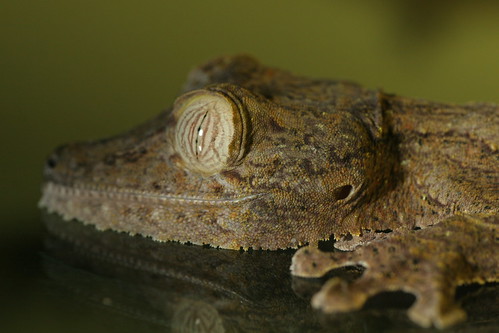
The Giant Frog-eyed Gecko (Teratoscincus scincus) is an adorable burrowing desert gecko from the Middle East. It would be a poor idea to cuddle them as they have exceptionally fragile skin that can be torn quite easily and they are very nervous geckos. It's possible rough handling could partially flay them. They have some of the thinnest skin of the geckos that do not use skin loss as a defense mechanism.

Wednesday, June 3, 2009

Common snakeneck turtle


Art
goal for the week 16hrs
today
work on floor tiles
make clay

Animal
The common snakeneck turtle (Chelodina longicollis) is an Australian turtle with a neck as long as the rest of it's body. It also has potent musk glands which give it another common name "the stinker" which they can spray up to 3 feet when threatened. They for some reason not uncommon as pets in Australia, perhaps they are difficult to frighten badly enough to spray.

Wednesday, May 27, 2009

feathered tree viper


Art
Goal for the week 17hrs
try to finish the sphinx

Animal


The feathered tree viper (Atheris hispida) is a small strange viper from central Africa. They have these long scales that bristle off their body in a way that one usually only sees in drawing of dragons and not so much in actual reptiles.  Like the Amazonian snail eater I mentioned a few weeks ago these also seems to specialize in soft bodied invertebrates. They tend to hang out basking on the very tops of trees. They do very poorly in captivity with a very high mortality rate even among experienced keepers.


Tuesday, May 12, 2009

Black Tree Monitor


Art
Goal for the week 19.5hrs
work on the sphinx

Animal

The black tree monitor (Varanus beccarii) is a 3 or 4 ft arboreal monitor from the Aru Islands of New Guinea. It was once thought to be a subspecies of the green tree monitor but is currently considered to be a separate species. Locally they are called "Waweyaro" the Kamoro supposedly do not eat them though I can't find a reason why. They have prehensile tail that assists them in climbing. It has been commented that they are reasonably intelligent for lizards. They are sometimes found in the pet trade but they are uncommon and the individuals tend to be wild caught as they are difficult to breed in captivity. 

Tuesday, May 5, 2009

Cuvier's Dwarf Caiman

Not feeling well tonight I think I'm coming down with something. Went to the goth event thing at c-street last night.  It was probably Greg's last time DJing in Champaign. They randomly had some guy eating fire and walking on broken glass it was a friend of Jill's I think. 

Art
Still off

Animal
Cuvier's Dwarf caiman (Paleosuchus palpebrosus) is the smallest of the crocodilians only reaching a length of about 3 feet. This make them quite popular as pets as unlike other crocodilians they stay a somewhat manageable size. They tend to be very aggressive for crocodilians in captivity, but have bred in captivity and can live up to 40 years. They tend to live in rivers and streams in north eastern South America it is theorized that their small size helps them to navigate through faster running water. They have the most bony plates of any crocodilian and they have some of the strongest stomach acid found in any known vertebrate.


Tuesday, April 28, 2009

Amazonian snail-eater

The cockroach living room disappeared. 

Art
Goal for the week 18hrs
Today work on the sphinx

Animal

The Amazonian snail-eater (Dipsas indica) is a small snake from tropical South America. They have unusual eating habits in that they specialize in slugs and snails. To find their mollusk they generally find a slime trail via chemoreception and follow it. The teeth on their lower jaw are long and well adapted to help them deal with viscous prey. For snails they will constrict the snail and then use their lower jaws to work snails out of their shells. They also have a serous gland in their lower jaw which may secrete a substance that helps them in removing snails from their shells. It is also thought that with their unusual jaw structure that they can triangulate their head to resemble a more dangerous snake like the pitviper Bothrops jararaca.

Tuesday, April 21, 2009

Ajolote Lizard


 Art
Goal for the week 18hrs
Today
Work on the sphinx

Animal

The Ajolote Lizard (Bipes biporus) is a two legged Amphisbaenian (worm lizards sort of the odd group out in the snakes and lizards of Squamata). They are found in California and Mexico. This reptile spends most of it's time burrowing, often near mesquite shrubs using it's legs to do most of the digging. They will occasionally leave there burrows at night to hunt surface dwelling insects, but they tend to be awkward on the surface. They eat mostly ground dwelling invertebrates and they have fairly large teeth (Here is a skull). Their ears are unusual for Amphisbaenians in that they have extra folds of skin and fibrous tissue that may be related to what developed into the epihyal bone found in the ears of mammals according to Ernest Wever and Carl Gans. It seems that this ear set up also gives them better hearing then other Amphisbaenians.

Friday, April 10, 2009

Elginia mirabilis

The cockroach living room is still outside my place of work though I notice people have been changing the position of the furniture. 

Art
goal for the week 14 hours
Today
work on the dragon


Animal 
drawing by Arthur Weasley photo by .:sandman

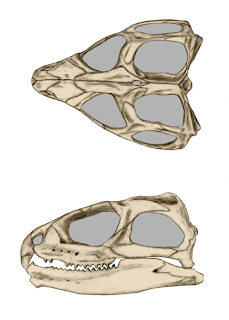
Elginia mirabilis was a small pareiasaur (about 2ft long) from Scotland during the Permian. Pareiasaurs are anapsid reptiles that may well be related to the things that became turtles. Turtles and anapsid reptiles have similar skull types and there is a debate as to whether turtles originated from this very early group or converged to having similar skull type. They have yet to find a lot of transitional turtle fossils aside from the 220 million year old Odontochelys. Elginia mirabilis was though to have been an herbivore and its impressive horns and bony plates were thought to be mostly for display. At the time Scotland likely would have been a desert so it might have been well adapted for dry conditions. It probably was not blue but how would you know.

Sunday, March 29, 2009

Red headed agama


Art
Today
work on sphinx

Animal
The red headed agama (Agama agama) inhabits sub-saharan Africa, and is invasive in Florida. They have adapted to life around human habitations reasonably well and so are fairly common. During the breeding season the males are very brightly colored and can become even more so if agitated. They also become very territorial and will often fight for good elevated positions. Red headed agamas have sticky mucus glands on the tip of their tongues that help them to hold on to prey. They also have relatively complicated teeth with with both canine like teeth for grasping and molar like teeth for crushing. Most of the red headed agamas in captivity tend to be wild caught, though they have bred in captivity, this makes them a poor choice for inexperienced reptile keepers.

Monday, March 16, 2009

Minute leaf chameleon

The sewer smells seems to be mostly taken care of. We had some drama at game last night, I will have to talk with one of my roommates.  

Art
Goal for the week 20hrs
Today
work on the figure with the Anubis mask
start the modeling clay sphinx figure.

Animal
The minute leaf chameleon (Brookesia minima) is a tiny chameleon from the island of Nosy Be off the coast of Madagascar. They are one of the world's smallest reptiles at just a little over an inch long. Like other chameleons they can change their coloration they tend to be a very dark brown when calm and almost white when agitated. Their prey includes tiny insects like fruit flies and springtails. When in danger they first rely on their camouflage to escape if this does not work, they feign death, and if they are gripped they will vibrate at a high frequency. They have been bred in captivity but their eggs are so tiny that the preferred method is to incubate them in the enclosure.


Thursday, March 5, 2009

Blue crested lizard

The Comptia website has very fast shipping. I got my book in less then 12 hours of ordering. I think that is a record.

Art
goal for the week 12.75 hrs
today
really need to make sketches
work on dragon 

Animal
Ok, this one is a bit of a "look pretty shiny lizard" article, they do not really do any tricks, nor biolumenese, they are not the sacred to the god of corn. It is shiny isn't it. The blue crested lizard (Calotes mystaceus) is a 15 inch bloodsucker agamid from southeast Asia they are also occasionally seen in the Florida everglades as an invasive species. No one can really agree on a common name for this lizard I've seen at least 6 in use so far. They are arboreal insectivores and the males tend to be more brightly colored then the females. They can also undergo a color change when stressed or excited. They are strangely not at all popular in the pet hobby despite the popularity of agamids. They have been occasionally found to be infected with mud fever (Dermatophilus congolensis), but this does not seem to be a common occurrence. 

Friday, February 27, 2009

European cat snake

Art
Goal for the week 11.75hrs
today
still sanding
buy a few (3 or so) little boxes for skull boxes

Animal
The European cat snake (Telescopus fallax) is found mainly on Greek islands and also the island of Malta. They are mildly venomous but are rear fanged and poses little threat to human. Lizards are their main prey, particularly geckos, which they inject with their rear fangs and then follow until the prey is subdued. These snakes have also gotten associated with an Orthodox miracle. On the island of Cephalonia, in the village of Markopoulo during the festivities to the Theotokos between August 5 and August 15 these snakes are said to come in numbers to the temple. The legend goes that nuns being attacked by pirates in 1705 prayed and were transformed into snakes to escape the pirates. I'm not sure if the nuns were supposed to have stayed snakes. (For former Necropolitians and House of Thornes in the know, the randomness of this miracle has a feel somewhat similar to "the miracle of the Christmas bats and the reasonably priced alcohol". Have you considered a reoccurring element?)

Saturday, February 21, 2009

Tuatara

Somewhat better today. 

Art
some sanding

Animal

Re-run from livejournal
The tuatara (Sphenodon punctatus) of New Zealand is not a lizard but one of the last surviving members of a mostly extinct group of reptiles the sphenodontians. They held the niche of lizards in the Mesozioc, but are completely unrelated to the lizards of Squamata today. Tuataras have a third eye with optic nerves in the center of their forehead that is visible when they are young and they have no external ears but can hear. Unlike all other living toothed reptiles they have an acrodont tooth structure which means that their teeth are fused to their jaw. They they have the slowest growth rate of the reptiles and a very slow rate of reproduction. Individuals can also live well over 100 years. For the Maori they are associated with Whiro the god of death and disaster. They are considered to indicate the borders between the mundane and the restricted sacred.

Here is a picture showing that third socket in the center of the skull

Tuesday, February 17, 2009

Stomatosuchus inermis

Art
Goal for the week 19.5hrs
today
sanding still

Animal
In the Middle Cretaceous in the swamps of northern Africa there was a crocodilian that became a filter feeder like a whale, Stomatosuchus inermis. It was over 40 feet long with a head that was around 6 feet long. It's upper jaw had hundreds of tiny teeth and it's lower jaw was toothless with a pelican like pouch. It is thought it would scoop water into it's throat pouch and then filter tiny invertebrates through it's teeth. It was thought to be almost fully aquatic returning to land only to lay eggs. Unfortunately very little study of this creature has been possible as the only known remains were destroyed in an allied bombing raid of the Munich Museum in 1944.

Sunday, February 8, 2009

Henkel's leaf-tailed gecko

Still sick. I saw Grace today she came to Champaign to assist with a friends table at our local gaming convention. She showed me a Brazilian tapir paladin she had been drawing at the convention, it turned out fairly well. She also suggested I look into last FM for looking into new music. So far the only problems she seems to have found with it being that it supplies you with a lot of Alien Sex Fiend (which I could probably do without) and randomly decides you like all music from a country, for example Grace was having a problem with it giving her a lot of Swedish disco.

Art 
Sick day

Animal
Henkel's leaf-tailed gecko (Uroplatus henkeli) is a strangely built arboreal 12 inch gecko from Madagascar and the island of Nosy Be'. They are nocturnal durning the day they scrunch themselves into a long oval head downward to avoid detection by predators. It is difficult to see in this picture but they also have these mossy little beards that hang off of their lower jaw. They can be quite variable in coloration, they are also somewhat sexually dimorphic with females being more grey and males being more brownish. Uroplatus geckos also have the most teeth of all living reptiles. Like other geckos they have vocal cords and when threatened will squeak loudly. They are becoming more threatened due to habitat destruction and collection by the pet industry. Though they have had reasonable success breeding this lizard in captivity so with an luck captive bred individuals will replace the wild caught individuals in the pet trade. 


Monday, January 19, 2009

Pancake tortoise

Last night I finished running the D &D campaign that I'd been GMing for a year and a half. The players ended up winning, I hope the end was not too anti-climatic there were a few mistakes I was fully expecting them to make that they avoided at the last second so it probably seemed a lot easier than it should have been.

Art
Goal for the week 20 hours
Today
paint the buffalo pipe horns
sand boxes

Animal

The pancake tortoise (Malacochersus tornieri) is a very flattened tortoise from Kenya and Tanzania. Often the pancake tortoise's shell is 6 or 7 inches long but only 1 inch high. For a tortoise they have a thin flexible shell that could easily be torn apart by predators so they spend most of their time crammed into the crevices between rocks. On their plastron they also have a flexible diamond shaped region they can wedge against the rocks making them difficult to dislodge. Their light shell allows them to run more quickly then other tortoises and also to right themselves quickly should they end up on their back. They will live communally with other pancake tortoises and sometimes as many as ten will share a favorable crevice. They tend to eat very tough vegetation and cactuses which they also get all of their water from. The collection wild individuals for the pet trade has not been kind to the wild population of these tortoises as they breed slowly and populations take a long time to recover. They have been successfully bred in captivity.

Tuesday, January 13, 2009

Rainbow Boa

I got strangely depressed yesterday, hopefully today will go better.

Art
Goal for the week still 20hrs lets try this again
Today
sand boxes

Animal

The Rainbow boa (Epicrates cenchria) is a lovely snake with an iridescent shine that comes from the Amazon Basin. The Brazilian rainbow boa (E. c. cenchria) is probably the most impressive subspecies of rainbow boa with their bright red and orange markings. The iridescent scales are due to microscopic ridges on their scales that act like tiny prisms. They tend to look best right after a shed when the ridges are newest. These snakes are not at all uncommon in captivity, and are not generally reputed to the friendliest snakes, but are being very successfully captive bred. My cousin is a stage magician in Pigeon Forge TN and used to have a fairly impressive Columbian rainbow boa (E. c. maurus) that would help out with his acts. I suppose it would be not to difficult to get a boid to sit quietly in a box.