Showing posts with label bird. Show all posts

Saturday, July 18, 2009

Bar Tailed Godwit


Lots of stress. Packing.

Art
Now that I have a nice protective layer on the sphinx divide the pieces of the mold off and put a coat on one piece
glaze rabbit and fly
raku fire rabbit and fly

Animal
The bar tailed godwit (Limosa lapponica baueri) breeds in Alaska and then winters in Australia. They complete this migration in one non-stop flight of over 6400 miles it can take them 175 hours. This is the longest non-stop flight known in any bird and they do this without feeding. Before they leave they double their body weight yet despite all the physical activity they do not arrive in Australia completely emaciated. Around the time of the flight their internal food processing organs shrink greatly in size and it is thought that this helps to balance out the new fat reserves they have just put on. The other subspecies have similarly long migrations ssp.lapponica goes from Scandinavia to southern Africa and ssp.menzbieri goes from Northern Asia to New Zealand.

Saturday, July 11, 2009

Crested Auklet


Art
Still carving the rabbit

Animal

The crested auklet (Aethia cristatella) nests in giant colonies numbering sometimes over 1 million birds in the Bering Sea. They are said to smell strongly like tangerines, so strongly in fact that humans can smell crested auklet colonies for miles. It is thought that the birds use the scent to find their colonies. Crested auklets eat mostly very small invertebrates such as krill and copepods.

Sunday, June 28, 2009

sociable weaver


Art
begin sculpting the ceramic parts of the rabbit and flower fly

Animal
The sociable weaver (Philetairus socius) is native to Southern Africa. They build enormous communal nests that may house up to 500 birds. The nests can represent 1000's of hours of labor and can last for up to 100 years. Some examples have been recorded to be up to 13 feet tall and 24 feet across split up in to individual apartments. On occasion other birds such as the pygmy falcon (Polihierax semitorquatus) will also take up residence in the nests.

Sunday, June 21, 2009

sword-billed hummingbird


Art
Probably not much today studying for the Comptia Network +

Animal

The sword-billed hummingbird (Ensifera ensifera) is a South American hummingbird with the longest bill to body proportion among birds. It specializes in flowers with long corollas such as Datura, passionflowers and fuchsias. These hummingbirds are a very extreme example of coevolution between pollinators and the plants they pollinate. It's bill is so large that it can not be used in groom so the bird grooms with it's feet. It must hold it's bill at a certain angle to fly and perch. They are also among the largest hummingbirds at 12 grams.

Saturday, June 13, 2009

Secretary Bird

I'm starting to get worried about this silicone I ordered it hasn't come in yet. 

Art
goal for the week 5 hrs
make clay
work on the figure with the Anubis mask

Animal
The secretary bird (Sagittarius serpentarius) is a terrestrial raptor from sub-saharan Africa with long stork-like legs. As its scientific name implies it does often eat snakes and other small creatures. It hunts by grasping the small creature and beating it against the ground. It is the national emblem of Sudan and the name secretary bird came from the Europeans who felt that it looked like the bird was wearing a coat and tails with quills behind it's ears.


Tuesday, June 2, 2009

Southern white faced Scops Owl

I discovered that I was out of silicone so I ordered some today.

Art
Goal for the week 18.5 hrs
make clay
make the floor tiles for the figure

Animal
The Southern white faced Scops Owl (Ptilopsis granti) comes from southern Africa. They will occasionally drive raptors out of their nests and take them over as their own. When nesting they will work cooperatively as a pair for the first two weeks the chicks are fed only by the male as the female incubates. After the first two weeks they will alternate hunting. They have also been known to fly long distances to find grass fires and then take advantage of the fact that the fire will drive small mammals into the open.

Tuesday, May 26, 2009

Southern Cassowary

I received a Zeraphine cd that I ordered from Russia today. One of the postal services along the way had actually punched a hole in the package to look at the contents.

Art
goal for the week 19hrs
still working on the sphinx

Animal 

I've had a few people ask me what a cassowary was since talking about having one guard an MDF. I'm kind of confused by this as I thought cassowaries were charismatic well known animals. So, I'll go with the Southern Cassowary (Casuarius casuarius) as it is the largest and most iconic cassowary of the three current species. They are the second heaviest bird and the largest Asian bird. While they are quite dangerous birds and there are many known attacks by captive cassowaries the bit about them disemboweling intruders was not very likely. It's possible that they could disembowel someone with a kick it has never been recorded happening. Despite this people have been keeping captive cassowaries for food and quills for a long time. Their call is very low being one of the lowest calls among birds. They can eat several fruits that are poisonous to other animals.  They also have quite a bit of mythology but that will probably be a separate entry at some point.


Monday, May 18, 2009

Horned screamer


Art
goal for the week 18hrs
Work on sphinx

Animal
The horned screamer (Anhima cornuta) is a relative of waterfowl that lives in tropical South America. It has a horn-like corneous that projects from the center of it's forehead and it has sharp spurs on its wings. The wing spurs are used in territorial disputes the spur break off frequently during these fights but will re-grow later. They are said to form monogamous pairs. Typically, they are not eaten by humans because their flesh is full of air sacs and considered unpalatable. 

Monday, May 11, 2009

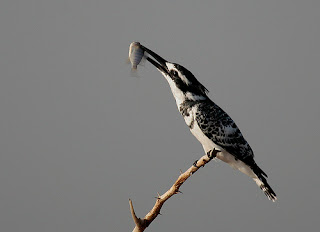
The Pied Kingfisher

Things went reasonably well with my parents. I ended up taking them to the Gordyville flea market as my mother wanted to look for antiques. We did not find any but they did have a lot of tiny puppies which went over well with her.

Art
Goal for the week 20 hrs
Today 
work on the sphinx

Animal

The pied kingfisher (Ceryle rudis) is the world's third most common kingfisher and it is native to Sub-Saharan Africa and Southern Asia. One of their closest relatives is the American green kingfisher and it is possible that they are descended from a population of them that crossed the Atlantic about a million years ago, but this is debated. Unlike other kingfishers they hunt in both fresh and salt water (the one pictured seems to be eating a cichlid).  They are the largest birds that can sustain a hover and will often hover as part of their fish hunting procedure. Three or four times a day they will cough up a pellet of undigested fish bones. It is thought that they have excellent color vision and can see into the ultraviolet range. They are also not terribly afraid of humans and tame well if fed.

Friday, May 8, 2009

Iberomesornis romerali

Today was sort of mind numbing at work. It should be slowing down with finals wrapping up. Maybe I will try to get out of the house tonight. Stuart and I got into a strangely long conversation about clove cigarette smell last night. I do have kind of a weird story regarding that. I was walking to the ceramics lab  during the period when I was getting my BA and it was way out in the middle of no-where in some metal shacks near the agriculture departments test fields and livestock. It was just dark and there was no breeze and I was on a road between a large empty field and a tiny cemetery. I hit this patch of clove cigarette smell on the middle of the road that was about ten feet in diameter and intensely strong like someone had smoked a whole pack of them. It was very concentrated to this one little spot. There was no one around and it really was not a good place to have done so no where to sit it was just in this big empty field no where near the entrance to the cemetery and not inside it at all. It was kind of a mystery did someone just stop in the middle of this road smoke multiple cloves then move on, stop smoke a bunch of cigarettes and drop a bottle of essential oil, invisible goth? I probably need better mysteries.

Art
still off

Animal

Iberomesornis romerali was an enantiornithine bird from the early Cretaceous that was found in Spain in 1985. It was about the size of a sparrow and while it retained a few unbirdlike characteristics like wing claws and teeth it was capable of true flight. Enantiornithine birds are also different from modern birds also in that their shoulder bones have a concave-convex configuration that is the inverse of modern birds.

Monday, May 4, 2009

Red-billed Quelea


Art
taking a week off to deal with personal things and cleaning

Animal

The red-billed Quelea (Quelea quelea) is one of the world's most populace wild birds with an adult breeding population of 1.5 billion. They are found over most of sub-Saharan Africa excluding areas with dense rainforest. They can form flocks of over 1 million birds that will feed in a group. They will prey on insects during the breeding season but most of the year they tend to eat grass seeds. Red-billed quelea have been unpopular with agriculture for thousands of years as they occasionally will feed on farm fields in this manner stripping them of all of their grain. Due to their swarming behavior they are also called locust birds. People have used fairly extreme measures try to control them such as dynamite, fire bombs, acids, and all manner of poisons, farmers kill roughly 200 million of them a year, not to mention a lot of other things.

Sunday, April 26, 2009

Red-tailed tropic bird

Today we went to see "What's Eating Gilbert Grape" as part of the EbertFest thing going on downtown. This particular movie was put on by the Champaign Mental Health board and somewhat loosely tied to the rest of EbertFest.  It was also the first movie I've ever been where it was announced they had counselors ready if you needed to talk to someone about the movie.

Art
work on the sphinx

Animal
The red-tailed tropic bird (Phaeton rubricauda) is an open ocean sea bird found in the Pacific Ocean. They are not terribly related to any of the other living birds though they look to me like penguins with all of the necessary changes needed to make them fly. The red-tailed tropic bird is the largest and rarest of the tropic birds. They generally only exhibit one red streamer feather at a time except during the breeding season when both are displayed. During their mating display they also appear to fly backwards. Their long red feathers were prized by the Maori and occasionally used as trade goods. In Hawaiian mythology the red-tailed tropic bird was the offspring of the gray migrating tern.


Monday, April 20, 2009

Cardinal

I have progress shot of the sphinx so far it is now ready for detailing.
Art
Goal for the week 20hrs
Today
 work on the sphinx
look up and order materials for stop motion puppets.

Animal


In Natchez mythology the cardinal (Cardinalis cardinalis) brought fire to humanity. There are several legends as to how the cardinal got it red color. In an Iroquoi story vulture gave cardinal his feathers when vulture decided that he did not look good in red while trying on the feathers of every bird. The cardinal got his red feathers from wolf in a Cherokee story in which  raccoon seals wolf's eyes shut with excrement while wolf is sleeping. Cardinal helps wolf get get the excrement off his eyes and as a reward wolf gives cardinal some red paint. The Algonquin have a story for how cardinal ended up a bird at all. In the story cardinal and blackbird were men that lived near a lake one day they went out of their normal territory to gather wild rice. The people in that territory asked them what they were doing and they explained that they were gathering wild rice because they were tired of wild potatoes. The people that lived in the area with the wild rice decided to kill cardinal and blackbird and steal their potatoes. Cardinal and blackbird got wind of this and fled the people in the form of birds. They never returned to human form for fear that the people would kill them. 

Sunday, April 19, 2009

Vampire Finch

Wasn't up for doing the mythology article today I will do one tomorrow. 

Art
Goal for the week 4.5 hours
Today 
work on the sphinx

Animal
Re-run from livejournal 
On the Galapagos island, Wolf island, there is a small black and brown bird that feeds on the blood of sea birds, mostly boobies. The vampire finch (Geospiza difficilis septentrionalis) is highly endangered bird that is sexually dimorphic the males being mostly black and the females being brown with stripes like most other female finches. It has been theorized that they had originally been removing parasites from the sea birds and gradually came to drink their blood instead. The sea birds seem unfazed by this and mostly sit still for the finches. They also will eat the eggs of the sea birds, seeds, and the nectar of Galapagos prickly pear. 

Monday, April 13, 2009

Black-crested coquette

I got very strange looks at our local hobby store today when getting puppet supplies. 

Art
Goal for the week 19hrs
Today
assemble first bits of armature for the fingers of the first stop motion puppet
drill into Serenity's base add weights and re-seal.

Animal


The black-crested coquette (Lophornis helenae) is a crested hummingbird from forested areas of Central America and Hawaii. It is being considered for the red list as there is speculation that there may be less then 10,000 of them left. Oddly its markings look a great deal like a 2 inch nectar eating sphinx moth Aellopos titan even down to having an antenna like crest. I was not able to find any reason for the mimicry, such as the moth being toxic, so I guess that is a mystery. Here a link to a picture of the moth.

Tuesday, April 7, 2009

Barnacle Goose

I went and saw the funker vogt show tonight. I've noticed goth and rivethead dancers tend to be strangely considerate of glasses during concerts. Tonight one of people from out of town had his glasses fly off and the whole section of the dance floor stopped and helped him locate them before resuming. I saw something similar happen at a Sisters of Mercy concert where Andrew Eldritch's sunglasses fell off into the crowd during the performance and the crowd politely handed them back rather then tearing them to pieces as one might expect from a concert crowd. Not to say that the crowd tonight was completely considerate there was also this guy that kept trying to crowd surf was got dropped head first at least twice.

Art
Goal for the week 20hrs

Animal
The barnacle goose (Branta leucopsis) is a striking black and white goose from Europe. It was once believed that they sprung from gooseneck barnicles (suborder Lepadomorpha) as the barnacles looked a bit like the geese and were believed to grow being found generally on drift wood. The barnacles were seen only in the summer while the geese were seen only in the winter and at that time it was unknown that birds migrate. The monk Giraldus Cambrensis claimed to witness geese springing from the barnacles. The pope also declared them fish because they sprang from barnacles, so they could be eaten on fish days. Actually, in the summer barnicle geese nest on cliffs in the artic. As the babies are not yet able to fly but must feed them selves, the first action a baby barnacle goose must take in life is to leap off a cliff and hope the fluff slows it's fall, quite a lot of them don't die.

Saturday, April 4, 2009

North American Teratorn

There are a lot of things going on this weeks so it has been a really bad art week.

Art
stuff

Animal
photo of a California Condor (which should have a very similar build) by bsterling that was then heavily modified.

The North American Teratorn (Teratornis merriami) was the largest flying bird man ever saw they went extinct around the end of the last ice age. While with it's 12ft wingspan it was not the largest flying bird that ever was it was still fairly impressive and it was thought that after went extinct stories about it endured as a supernatural creature. There are theories that it was the origin of the thunderbirds. Thunderbirds are large intelligent bird shaped spirits that can control storms and thunder you find in a lot of forms of them in the mythology of a number of Native American tribes. In Wisconsin there is a lake called Devil's lake (Tawacunchukdah) that I'm very fond of that gets tied into the thunderbirds (Wakunja) mythology of the Winnebago. It was supposed to have been a site where the underwater pumas and the thunderbirds had a fight and threw a lot of large rocks and lighting at each other. I got to spend quite a bit of time a kid crawling around on the spent weapons of old gods there. The Cowichan also had a thunderbird (Tzinquaw) that had a fight with a water spirit this one in the form of an Orca. The Sioux had thunderbird had wiped out the Unktehila a dangerous reptilian water monster,  so there seems to be a bit of theme thunderbirds and water spirits not getting along. Not that there were not other giant birds in mythology that were not thunderbirds but may have been influenced by Teratornis. The Miwok had a giant man-eating bird named Yellokin that was eventually killed by eagle and turned into trees by coyote. The Passamaquoddy had a giant bird Wuchowsen that created wind with it's wings.  Cryptozoologists also love these guys, there are occasionally stories about modern giant bird sightings, though many ornithologists point out if there were physical living Teratorns running around the small army (84 million according to a survey in 2000) of American bird watchers probably would have noticed.

Saturday, March 28, 2009

Dovekie

I think that I will be getting a drill press for the stop motion project and also because it would be useful for other pieces as well.

Art 
goal for the week 8 hours
Today
cleaning
get a drill press ?

Animal

The Dovekie (alle alle) is a robin sized bird that is one of the smallest members of the auk family. They are odd as they are specialized filter feeders that strain plankton through tiny tooth-like structures in their beak. The live in the northern arctic, with greenland being their main stronghold they can range as far south as new Jersey in the winter. They breed in very large colonies numbering in the millions, and their plumage changes fairly dramatically during the breeding season. They are occasionally driven off course in very large numbers by storms in one case in 1930, 1000 dovekies were found in Sydney Australia.

Sunday, March 22, 2009

Spotted pardalote

Sorry forgot to post yesterday. Stuart and I went out of town to a wildlife park near Peoria called Wildlife Prarie Park. It is a nice park it features a lot of animals they wished were still native in Illinois and a few that still are. The enclosures were huge and well forested for the most part and most of the animals were rehab cases that could not be released back into the wild. They had an entire pack of wolves which we got to hear howl all together for about 5 to 10 minutes. They also had a massagua rattlesnake which I often think of a quasi-mythical, they are supposed to be native to this area but are so endangered you would never see one. I tried to get a few pictures but only managed to get clear ones of the copperhead and the bobcats.

Art
Not sure what is going on today
work on the sphinx

Animal
The spotted pardalote (Pardalotus punctatus) is one of the smallest birds in southern Australia. They tend to spend most of their time hidden among the eucalyptus. When they nest they tend to do so in burrows, but can get creative with their definition of a burrow. They have also been found nesting in rolled carpets, closed garage door, and the crevices of buildings. Studying their nest had been traditionally very difficult recently Christopher Boland and Robert Phillips developed a method to build an inexpensive burrowscope which can be made for around $400 and they have had a lot of luck with it. Here is a link to the the paper the device is featured in the paper is unfortunately not free but there is a free picture of the device and a complete materials list at the bottom. It strikes me as a neat thing for biologists and perhaps biology teachers.

Thursday, March 19, 2009

Hesperonis regalis

I'm shifting schedules a little I think. I'm going to try to get a longer block of work in at night and sleep during the day.

Art
Goal for the week 14.5 hours
Today
make clay
work on the sphinx

Animal

Hesperonis regalis was a prehistoric flightless aquatic bird from the late Cretaceous it was found in the marine limestone from Kansas. It was found in the late 19th center and was an important early find in avian paleontology. It had teeth in it's beak which it used to hold down prey and lobed toes that acted like webbing. Early depictions showed them standing upright like penguins but it is unlikely that they could do that, they may not have been able to walk on land at all. It is thought that they got around on land by sliding on their belly it is also thought that they were migratory as more juveniles were found in northern sites.