Showing posts with label invertebrate. Show all posts

Thursday, July 9, 2009

Sloan's Urania


We have a lot of packing to do. I'm also going to probably have to give up a lot of the found objects I've gathered in the studio. Hopefully I will find some people that could use boxes of high quality garbage.

Art
still carving the rabbit
Hopefully bisque firing the rabbit and soldier fly

Animal
Sloan's Urania (Urania sloanus) was a day flying moth with interference based colors similar in appearance to the Lolonandriana I mentioned a while ago. It was native to Jamaica and has not been seen since 1895. It is thought that it was wiped out as the Jamaican low land forests were cleared for farm land. Currently only one preserved specimen of the moth exists in the Peale collection at the Academy of Natural Sciences in Philadelphia. It was named after the Muse Urania that specialized in astronomy and astrology.

Wednesday, July 8, 2009

Fire Beetle


Art
carve rabbit

Animal
The fire beetle (Pyrophorus noctilucus) has the brightest bioluminescence of any insect. It is bright enough to read by at 45 millilamberts. Unlike a firefly it can not turn off it's bioluminescence but it can brighten and dim. The bioluminescent spots are on it's thorax and resemble LED's. It is native to Central and South America as well as the Caribbean.

Thursday, June 25, 2009

Curved Spiny Spider


Art
paint the cricket

Animal
The curved spiny spider (Gasteracantha arcuata) is a small orb weaver with a spiny abdomen from southeast Asia. They are sexually dimorphic, the males are much smaller and lack the giant horns. It is thought that the horns make them less palatable to predators. They have a tendency to build their webs in places where they might be disturbed by flying birds so they will actually build visible tuffs of silk into the web, it is theorized that these help the birds avoid their webs.

Wednesday, June 17, 2009

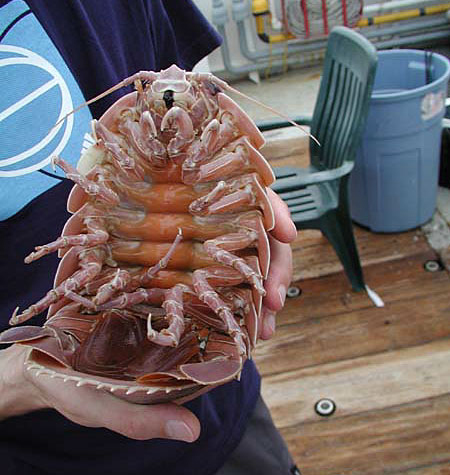
Giant Isopod


Art
glaze and fire the ceramic cricket bits

Animal
The Giant Isopod (Bathynomus giganteus) is a bit like a thing from a horror movie, it is part of the order of crustaceans that contains rolly pollies (pill bugs (Armadillidium vulgare)), but grown out of control. They are about as related to rolly pollies as weasels are to walruses but they look a good deal like them in a giant version. They are the largest know isopod and come from the benthic zone of the ocean where they have been for the last 160 million years functioning as scavengers. They are eaten in Taiwan and described to taste like crab.

Wednesday, June 10, 2009

Ebony jewelwing

The vacation is over now. I had a good time we stopped several places and saw a lot neat things. We stopped first at the Exotic Feline Rescue Center in Indiana. I got several good pictures of large cats. If you have never been to it and like to visit large cats I highly recommend it the cats there seem reasonably happy and active. I don't recommend bringing very small children as they seem to kind of excite the predatory side of quite a few of them. I'll get into some of the other stuff later in the week. 

Here is an upside-down puma


Art 
goal for the week 9hrs
fire tiles
make clay
work on Anubis masked figure
net +

Animal

The ebony jewelwing (Calopteryx maculata) is a damselfly from northeastern North America. I happened to see a lot of them this weekend at a wildlife refuge we stopped at on the way back.  I had been previously unaware there were black winged damselflies and thought I would share. They are sexually dimorphic the females have a white spot on their wings and the males have solid black wings. They eat small arthropods and tend to live near small creeks.
Here is a better photo of a male

Saturday, May 30, 2009

Twin head-tailed monster


Animal 

Dicranurus monstrosus or since Dicranurus translates to twin head-tail, the twin-head tailed monster was a lower Devonian trilobite with an unusual array of spines. It looks a bit like the shadow ships from Babylon 5 except with ram horns. It is thought that the spines may have been for defense against early jawed fish such as smaller relatives of the Dunkleosteus. The spines also may have been useful for holding the trilobite out of the mud. They were found between Euramerica and Gondwanaland. Most of the fossils of this species today are found in Morocco. They are very popular with trilobite collectors

Friday, May 29, 2009

Giant Palouse Earthworm


Art
goal for the week 15hrs

Animal

In the Palouse area of Idaho and Washington state there is a 3ft white earthworm that smells of lilies. The giant worm also will spit as a defense mechanism. The giant Palouse earthworm (Driloleirus americanus) was believed extinct but a specimen was recovered in 2005 along with several reliable sightings. Since it was rediscovered many conservation groups would like to list it as an endangered species as its habitat is disappearing and it was once described as abundant and is now is very rare. The U.S Fish and Wildlife service has rejected the request of these groups to list the worm citing lack of evidence. It has been implicated that the U.S Fish and Wildlife service's intentions were more politically motivated in rejecting the worm then based on lack of evidence.

Friday, May 22, 2009

Acteon beetle

Still strangely depressed. Network + studying is coming along.

Art
goal for the week 17hrs
Today
work on and hopefully finish sphinx

Animal
The Acteon beetle (Megasoma acteon) is one of the world's heaviest insects. It might well be the heaviest but that seems to be open to debate. For example gravid giant wetas (really, really big crickets) are heavier, but does it count if it is only heavier when gravid... stuff like that. They are about 4 inches long and quite bulky. Acteon beetles are native to northwestern South America, and I've not found anything that directly says they are found in the rain forest but they seem to thrive in a deep mulch with 90% humidity so I'm guessing. They are carpusluar and mainly found in the evenings between January and November. Vegitation and rotting wood seem to be their main food sources. Males and Females differ greatly as the males have three prominant horns one on their head and two off their thorax. The females have no horns. They are very strong beetles and can easily rip through screen mesh and their exoskeleton is described as thick almost crab-like. Apparently if placed on their back on a smooth surface they can not right themselves and can die if left in that position. The larva which are also quite large and can weigh as much as 1/12500th of a ton, also the larval stage is much longer then the adult stage. The adults tend to live 100-150 days while the larva take 3 years to reach maturity. Even their eggs are quite large often exceeding 2 inches in lenght beforh hatching. The eggs have a very long incubation period for an insect taking up to a month to hatch.

Megasoma Acteon was described by Linneaus in 1758, and retains its original name. This is significant as Linneaus was the one that developed the basis of the taxonomic system used today. Carl Linneaus is known as "the father of Taxonomy" he developed the concepts of hiearchical classification and binomial nomerclature still in use today. He also under went the giant task of trying to classify all known life. Most of his of his original classifications have been disputed, further examined, and changed. So the Acteon Beetle has one of the oldest scientific names that is still in use. This beetle's name probably references mythology, Linneaus seems to have used a lot of gods and mythological figures in the names he gave. For example another beetle with a vaguely canine-like head in the genus Megasoma, that was named by Linneaus is Megasoma anubis. Megasoma acteon probably came from the story of Actaeon the hunter (Acteon in french), who came upon Diana goddess of the hunt bathing in the forest. Diana was angered that Actaeon had seen her and turned him into a stag, which was dismembered by his own hounds. The beetle was probably named Megasoma acteon to refer to the stag-like horns of its thorax.

Thursday, May 14, 2009

Lolonandriana

For the record My pancreas (like Rick's) has no medicinal benefits.

Art
goal for the week 18.5 hr
work on the sphinx

Animal
photo by Cody Hough 
The Lolonandriana (Chrysiridia rhiphearia) is a moth that is native to Madagascar and migrates to Asia it is often considered one of the most striking Lepidoptera. It does not have pigment, its color instead comes from interference on it's wing scales so it is a bit difficult to get a true impression of the moth from photographs but if you have seen much dichroic glass you can probably get the idea. The moth's bright colors are a warning of its toxicity. Some of the Native Malagasy believe that this moth is a form that their dead ancestors souls would take to inhabit the earth, so to destroy the moth would be an attack on their ancestors. I would guess that they were just thrilled to death by all of the vast interest by butterfly collectors, can't find any real information on how that went.

Friday, May 8, 2009

The Blue Dragon

I went to Stitches tonight. Tonight we worried Rick that Bill may be trying to steal his pancreas with the aid of two priests. We also had a very drunk man ask us if we were alive. 

Art
still off

Animal

The blue dragon (Glaucus Atlanticus) is the only sea slug in the genus Glaucus, it travels along upside-down being held aloft by a gas bubble in it's stomach. It is a part of a group of organisms dubbed "the blue fleet" by Sir Alistair Hardy. They are open ocean invertebrates that travel around colonies of Portuguese man-o-wars and other Cnidarians being carried by the wind. The blue dragon is much smaller then the Portuguese man-o-war but is actually one of it's predators, it is completely immune to the venom. Upon eating a Portuguese man-o-war it actually stores the venom in at the tip of it's cerata, those wing-like structures, in a more concentrated form which makes it far more venomous then the man-o-war. The name Glaucus comes from a greek sea god translate to the color of the sea.

Thursday, April 30, 2009

Lord Howe Island stick insect

I talked to a friend tonight at goth night about using bones for odd purposes. He was telling me about a corset he had made with a trim made out of little bones. He said he had to eat a lot of chickens to get them all. I've had pretty good luck with owl pellets myself for sculpture stuff.

Art
Goal for the week 16.5 hrs
Today
 work on the sphinx

Animal
The Lord Howe Island stick insect (Dryococelus australis) is probably the world's most endangered insect. They had once been abundant on Lord Howe island near Australia but were thought to have been completely wiped out by black rats in the 1930's. In 2001 about 30 of them were discovered on a tiny isolated treeless sea stack called Ball's Pyramid living under a Melaleuca shrub. Four of them were removed two were taken to the Melbourne zoo and two given to a private breeder in Sydney. There are now about 15 times the wild population living in captivity and there are plans to reintroduce them to Lord Howe island after the rats have been removed.  Current predictions are that this will happen around 2011. 

Friday, April 24, 2009

Giant Sea Scorpion

I'm nearly done cataloging all of the channels the company I work for offers at all of the sites with video. They basically had me confirm the station of every channel at about 50 or 60 sites from a slingbox. It was odd that they are having me do this as I have not really watched television consistently for about 8 or 9 years so I'm not really familiar with the shows and I'm really bad with celebrities for movie identification. I was kind of horrified to find that there is an entire reality show based station, perhaps more then one. Also something weird happened to the Learning Channel, they don't seem to do documentaries anymore.

Art
Goal for the week 13hrs
Today work on the dragon  

Animal

Stuart had somehow not heard about the giant 8ft prehistoric sea scorpions (Jaekelopterus rhenaniae) they found somewhat recently. So, I thought that I would do those today, then I discovered there were no usable pictures. Finally I got frustrated and decided it would be faster to draw one only to find that there is considerable disagreement as far as how many legs and body segments reconstructions of sea scorpions seem to have. I gave up and drew something that I thought looked kind of like that sea scorpion. The giant sea scorpion was found in Germany and seems to be mostly known from a claw fossil. The rock around the claw suggests that it lived in brackish areas. They may well be the largest invertebrates or at least one of them. It is thought that they would not have been able to support it's weight on land and so would not have been able to leave the water.

Thursday, April 23, 2009

Striped Pyjama squid

Bill is trying to get Stuart to learn programming. 

Art
Goal for the week 15.5hrs
Today
Work on the sphinx

Animal
The Striped Pyjama squid (Sepioloidea linolata) is a golfball sized cuttlefish from southern Asia and northern Australia. It is one of only two known poisonous cuttlefish. They have little finger-like projections around their eyes to help keep sand out of them.

Thursday, April 16, 2009

Giant tailless whip scorpion

Could not find any baling wire in the house yesterday so that kind of stopped the work on Serenity last night. 

Art
Goal for the week 14.5 hrs
Today
attach the arms to Serenity
finish painting Serenity's hands to match the rest of the body
Other touch ups
work on sphinx

Animal
The giant tailless whip scorpion (Damon diadema) is a very unusual arachnid from Africa. They are not true scorpions but are in a distinct arachnid order. Their first set of legs have become modified sensory organs that function like antenna. They do not have venom glands but they do have pair of pedipalps with pincers that they use to break up their prey. As a defensive behavior they can break off bits of their legs when grasped, they later regenerate the legs. While there is not a lot of good data about their lifespan they have been observed to live at least ten years in captivity and mature adults continue growing throughout their lives reaching lengths of up to 8 inches. Very unusual for arachnids they show kin recognition in behavioral studies. Young will remain close to their mothers and interact with them. Related young will also stay together in a group in unfamiliar surroundings.

Thursday, April 9, 2009

Baler volute


Art
Goal for the week 15hrs
today 
sphinx

Animal
The baler volute (melo melo) is a very large snail found in Indonesia. They are specialized predators of other predatory gastropods. Odd for a snail they can produce pearls when bits of sand get stuck in their shells. The pearls are large, but lack nacre and their color tends to fade over time. The baler volute is also getting to be quite threatened particularly in Singapore among other places so hopefully the pearls will not catch on.  They are also eaten as a delicacy. They are called baler volutes because their shells were traditionally used to bail water out of boats. 

Tuesday, March 31, 2009

Happy faced spider

Yesterday, I should have been doing art but instead I killed a lot of giant naked mole rats in fallout 3.

Art
Goal for the week 20hrs
Today 
work on the sphinx

Animal

The Hawaiian happy face spider (theridion grallator) is a kind of ironic animal, it has highly variable markings but often has a smiley face on it's abdomen. It is theorized that it's odd markings help to keep away birds and other predators, however they really are not sure about that. A really bizarre thing about it's marking is the pattern of inheritance varies depending upon which of the islands it is on. On Maui the spiders inherit there markings in a very predictable Mendelian way. On on other islands the patterns are sex limited. In some cases its color is altered by the food the spider is eating. They are also odd in that the female actually cares for her young, she guards the eggs until they hatch, then brings food to the newborn spiders.

Wednesday, March 25, 2009

Giant squid

I think this is the 100th post. Having shifted my schedule it is a little harder to post in the morning so I may be posting at night more frequently.

Art
Goal for the week 14hrs
today
work on the sphinx

Animal
Mythology
It gets a little hard to do the mythology of specific invertebrate species past a certain point since most people generalize them into types that cover quite a few species. The giant squid of the Architeuthis genus (of which they estimate there are between 3 and 8 species) have generated quite a bit of mythology since they are essentially sea monsters. In Norway and Iceland they can probably be linked to the Kraken. The Kraken was often described as a giant squid or crab-like monster that resembled an island and attracted fish. It was said that fishing was good directly over a Kraken, though it was also said that they would occasionally attack and pull down ships. The giant squid may also be the source of the sea monk a really weird looking thing from Denmark. Another creature, a bearded whale reported by Olaus Magus a Swedish writer might have also been a giant squid, though it does seems to have a happy little dog/seal face and claws added. Giant squid are also said to be minions of Cthulhu at many of the conventions I attend.

Wednesday, March 18, 2009

Eastern bloodsucking conenose

I'm having  hard time finding good blocks of time to work on art. I tend to get better results from longer blocks of time. I may start experimenting with new schedules. 

Art
Goal for the week 18.75 hours
Today
make clay
work on the guy with the Anubis head

Animal
The eastern bloodsucking conenose (Triatoma sanguisuga) is an assassin bug that ranges all over from the eastern United States to South America. Assassin bugs in general prey on other insects such as cockroaches and bedbugs and a number of the very beneficial north American assassin bugs also have the spots on side and that general body shape so one should take care not to jump to conclusions. The eastern bloodsucking conenose does feed on the blood of vertebrates particularly rats and mice though it is not completely unheard of for them to go after sleeping humans. When they do bite humans it is generally around the mouth. The nymphs have a sticky coating on their body that they use to pick up dust and debris to help camouflage themselves. They are long lived insects and can take 3 years to fully develop. Their feeding bite is generally painless , but they should  be handled  carefully as they also have a defensive bite that is very painful and can cause nausea and in some cases severe allergic reactions. 


Sunday, March 8, 2009

Hallucigenia sparsa

I'm having to make all of this clay because I was really dumb and let my 6 year old Grolleg porcelain dry out. Sketches are done, made some porcelain, guess I'm really ready to get started. 

Art
goal for the week 6 hrs
Today
make more clay
Start making parts of the figure with the Anubis mask
get a little more modeling clay for the sphinx figure sculpt

Animal

Hallucigenia sparsa was a tiny (about 1 inch long) middle Cambrian invertebrate that was found in the Burgess Shale of British Columbia. I was discovered in 1979 by Conway Morris and dubbed Hallucigenia because it was so oddly put together. Morris depicted the animal as having a double row of spines that it walked on and a single row of feeding tentacles along its back. See the linked picture below. Critics pointed out to Morris that there were no known animals that walked on spines but Morris pointed out that he had found only a single row of tentacles on the animals back and these would not have made effective legs. In the late 1980's a dentist that had become a paleontologist named Lars Ramskold got permission from the curator of the Walcott Collection to excavate for a second set of tentacles to see if they could have acted as legs. This permission was very odd as this fossil was exceptionally rare and it was amazing that they would allow this sort of excavation which would damage it. Lars excavated and found the second set of legs, they then were able to flip the creature over and the little hooked tentacle legs were like other animals they had seen before in the line of ancestors of the velvet worms. Some of the ancestors of the velvet worms also had spines.


Saturday, March 7, 2009

Lettuce sea slug

We saw Watchmen last night it was truer to the comic then I had thought it would be. I finally have the compositions worked out for the fine art pieces. Now I just need to work out how the internal supports and channels for the wire are going to fit together. Unfortunately, all of my ideas this time were very complicated so I'm probably looking at 2 100+ hr pieces. So if I'm good I'm probably looking at June or July for those.

Art
goal for the week 11.75 hrs
today
do internal armature sketches
put slake on plaster, wedge, make more clay
Start the guy with the Anubis mask or work on wax dragon depending on clay availability


Animal  
The lettuce sea slug (Tridachia crispata) is a not uncommon sea slug from the Caribbean. They can range quite a bit in coloration from white to red to solid electric blue. They are herbivores but eat in an odd manner. They insert a fine tube into the plant and actually suck out the contents of the cells. They have been described as like a mosquito for algae. By removing the cell organelles from algae they can actually incorporate the chloroplasts into themselves and to some extent produce their own food from sunlight. They do also digest the other plant organelles that are not chloroplasts. They also produce a bad tasting compound from the organelles called chlorodesmin that helps to protect them from being eaten. They are sometimes kept in the aquarium hobby. They are said to control algae but don't really eat it at a high enough rate to be very effective at this.