Showing posts with label Africa. Show all posts

Saturday, July 18, 2009

Bar Tailed Godwit


Lots of stress. Packing.

Art
Now that I have a nice protective layer on the sphinx divide the pieces of the mold off and put a coat on one piece
glaze rabbit and fly
raku fire rabbit and fly

Animal
The bar tailed godwit (Limosa lapponica baueri) breeds in Alaska and then winters in Australia. They complete this migration in one non-stop flight of over 6400 miles it can take them 175 hours. This is the longest non-stop flight known in any bird and they do this without feeding. Before they leave they double their body weight yet despite all the physical activity they do not arrive in Australia completely emaciated. Around the time of the flight their internal food processing organs shrink greatly in size and it is thought that this helps to balance out the new fat reserves they have just put on. The other subspecies have similarly long migrations ssp.lapponica goes from Scandinavia to southern Africa and ssp.menzbieri goes from Northern Asia to New Zealand.

Monday, June 29, 2009

Malagasy Rainbow Frog


I may be posted in a not very regular manner for the next month and a half. We are doing a long distance move soon and I will likely have a few periods where I have no internet connection. (It is also going to cut into the Art quite a bit). Things should get back to normal after that.

Art
work on ceramic parts of rabbit and not flower but soldier fly

Animal

The Malagasy rainbow frog (Scaphiophryne gottlebei) lives in narrow sandy canyons in the Isalo Massif area of Madagascar. They burrow in the sandy substrate much of the time and will climb the vertical rocky walls of the canyons they live in for several meters. Tadpoles of this species have a psammonektonic feeding behavior durning the day the sit along the bottom at a 45 degree angle and filter feed on the substrate then at night they swim freely feeding as well. They are critically endangered for a variety of reasons habitat destruction logging, fire, and overgrazing being the big one. There is also a great deal of concern about sapphire mining activities in their range. It has also been determined that a significant cap needs to be put on the number of individuals collected for the pet trade the Edge suggests no more then 1000 individuals per year. While they recover very well from individual predation their range is too small to sustain the level of collection that currently occurs, so it is currently very damaging. While they have not yet successfully bred and fully reared in captivity it is thought that there is reasonably good potential that they can be bred in captive conditions, it is the hoped that extremely limited collection will allow a breeding captive population to be established.

Sunday, June 28, 2009

sociable weaver


Art
begin sculpting the ceramic parts of the rabbit and flower fly

Animal
The sociable weaver (Philetairus socius) is native to Southern Africa. They build enormous communal nests that may house up to 500 birds. The nests can represent 1000's of hours of labor and can last for up to 100 years. Some examples have been recorded to be up to 13 feet tall and 24 feet across split up in to individual apartments. On occasion other birds such as the pygmy falcon (Polihierax semitorquatus) will also take up residence in the nests.

Thursday, June 18, 2009

Devil Toad


Studying for the Network +

Art
glaze the rest of the cory cat
begin assembly on the cricket

Animal

The devil toad (Beelzebufo ampinga) was a giant toad that existed durning the Cretaceous Period in what is now Madagascar. It was about 16 inches long and was thought to have weighed over 10lbs and is thought to have been the largest frog that has existed. It's closest living relatives are the horned frogs such as the Pacman frog (Ceratophry cranwelli). It is speculated that they were terrestrial and like their living relatives quite aggressive.

Saturday, June 13, 2009

Secretary Bird

I'm starting to get worried about this silicone I ordered it hasn't come in yet. 

Art
goal for the week 5 hrs
make clay
work on the figure with the Anubis mask

Animal
The secretary bird (Sagittarius serpentarius) is a terrestrial raptor from sub-saharan Africa with long stork-like legs. As its scientific name implies it does often eat snakes and other small creatures. It hunts by grasping the small creature and beating it against the ground. It is the national emblem of Sudan and the name secretary bird came from the Europeans who felt that it looked like the bird was wearing a coat and tails with quills behind it's ears.


Tuesday, June 2, 2009

Southern white faced Scops Owl

I discovered that I was out of silicone so I ordered some today.

Art
Goal for the week 18.5 hrs
make clay
make the floor tiles for the figure

Animal
The Southern white faced Scops Owl (Ptilopsis granti) comes from southern Africa. They will occasionally drive raptors out of their nests and take them over as their own. When nesting they will work cooperatively as a pair for the first two weeks the chicks are fed only by the male as the female incubates. After the first two weeks they will alternate hunting. They have also been known to fly long distances to find grass fires and then take advantage of the fact that the fire will drive small mammals into the open.

Wednesday, May 27, 2009

feathered tree viper


Art
Goal for the week 17hrs
try to finish the sphinx

Animal


The feathered tree viper (Atheris hispida) is a small strange viper from central Africa. They have these long scales that bristle off their body in a way that one usually only sees in drawing of dragons and not so much in actual reptiles.  Like the Amazonian snail eater I mentioned a few weeks ago these also seems to specialize in soft bodied invertebrates. They tend to hang out basking on the very tops of trees. They do very poorly in captivity with a very high mortality rate even among experienced keepers.


Sunday, May 24, 2009

Coquerel's Sifaka

Art
stuff

Animal

Coquerel's Sifaka (Propithecus coquereli) is one of nine known species of sifaka all of which are found on the island of Madagascar they are very genetically distinct from other lemurs as a group. Coquerel's Sifakas are very matriarchal and even sub-adult females are dominant over males. Females have preferential access to food sources and males will wait until the group of females have moved on from a tree before moving into feed. They also have an interesting way of getting around on the ground in that they jump forward like kangaroos. In some regions of Madagascar killing and eating these sifakas is considered a fady (taboo) but I can't seem to find the reason why which is too bad I have a feeling there is a story there.

Wednesday, May 20, 2009

Grey bicher


Art
Goal for the week 17.5 hrs
Today work on sphinx

Animal
I ran into these guys for the first time while picking up crickets at a Petsmart labeled as "Dinosaur eels" and thought they were very oddly built fish with all of the spikey little fins in back. The grey bicher (Polypterus senegalus) is an African fish that is from an ancient group of fishes that are mostly cartilaginous but have some bone.  They also have rudimentary lungs and so breathe a little bit from the air as well as the water. One of their lungs stretches almost the entire length of their body. Here is an animation (towards the bottom of the page) that shows that.  The grey bicher also has very well armored scales that may be inspiring future military armor. 

Thursday, May 14, 2009

Lolonandriana

For the record My pancreas (like Rick's) has no medicinal benefits.

Art
goal for the week 18.5 hr
work on the sphinx

Animal
photo by Cody Hough 
The Lolonandriana (Chrysiridia rhiphearia) is a moth that is native to Madagascar and migrates to Asia it is often considered one of the most striking Lepidoptera. It does not have pigment, its color instead comes from interference on it's wing scales so it is a bit difficult to get a true impression of the moth from photographs but if you have seen much dichroic glass you can probably get the idea. The moth's bright colors are a warning of its toxicity. Some of the Native Malagasy believe that this moth is a form that their dead ancestors souls would take to inhabit the earth, so to destroy the moth would be an attack on their ancestors. I would guess that they were just thrilled to death by all of the vast interest by butterfly collectors, can't find any real information on how that went.

Monday, May 11, 2009

The Pied Kingfisher

Things went reasonably well with my parents. I ended up taking them to the Gordyville flea market as my mother wanted to look for antiques. We did not find any but they did have a lot of tiny puppies which went over well with her.

Art
Goal for the week 20 hrs
Today 
work on the sphinx

Animal

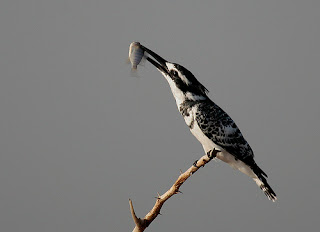
The pied kingfisher (Ceryle rudis) is the world's third most common kingfisher and it is native to Sub-Saharan Africa and Southern Asia. One of their closest relatives is the American green kingfisher and it is possible that they are descended from a population of them that crossed the Atlantic about a million years ago, but this is debated. Unlike other kingfishers they hunt in both fresh and salt water (the one pictured seems to be eating a cichlid).  They are the largest birds that can sustain a hover and will often hover as part of their fish hunting procedure. Three or four times a day they will cough up a pellet of undigested fish bones. It is thought that they have excellent color vision and can see into the ultraviolet range. They are also not terribly afraid of humans and tame well if fed.

Sunday, May 10, 2009

Springhare

My parents are coming to Champaign today. Hopefully that will go alright.

Art
off

Animal

The Springhare (Pedetes capensis) is the only member of its family it is an eight pound south african rodent resembling a small kangaroo or rabbit. Generally they get around by hopping not unlike a kangaroo and they can leap up to 6 feet. They spends a good deal of their time standing up right and have a serious over bite even for a rodent. Their lifespan is generally about 15 years and they take 2 years to reach maturity. Springhare were threatened for a time but have recovered, they now can occasionally be found as exotic pets.

Monday, May 4, 2009

Red-billed Quelea


Art
taking a week off to deal with personal things and cleaning

Animal

The red-billed Quelea (Quelea quelea) is one of the world's most populace wild birds with an adult breeding population of 1.5 billion. They are found over most of sub-Saharan Africa excluding areas with dense rainforest. They can form flocks of over 1 million birds that will feed in a group. They will prey on insects during the breeding season but most of the year they tend to eat grass seeds. Red-billed quelea have been unpopular with agriculture for thousands of years as they occasionally will feed on farm fields in this manner stripping them of all of their grain. Due to their swarming behavior they are also called locust birds. People have used fairly extreme measures try to control them such as dynamite, fire bombs, acids, and all manner of poisons, farmers kill roughly 200 million of them a year, not to mention a lot of other things.

Saturday, May 2, 2009

Western Tree Hyrax

I may take a few days off of art to take care of life and moving stuff. 

Art
goal for the week (not going to happen)

Animal
The western tree Hyrax (Dendrohyrax dorsalis) is a small mammal from western and central Africa that of the other living mammals today (besides other hyraxes) is most closely related to elephants. Hyraxes are not directly related to elephants but represent a different branch of mammals that developed off of the prehistoric giant hyracoids. Like elephants they have similar foot pads and toenails, there are also skeletal similarities. Hyraxes also have enlarged incisors which are very rodent-like. Tree hyraxes are arboreal and can use their foot pads to cling to branches. Unlike other hyraxes the western tree hyrax is mostly nocturnal. They are mostly herbivores but will on occasion also eat insects. Chimpanzees in Bossou Guinea have occasionally been observed to capture western tree hyraxes then carry them around for several hours occasionally grooming the hyrax and the Chimpanzees were not observed eating the hyraxes durning these sessions.


Thursday, April 16, 2009

Giant tailless whip scorpion

Could not find any baling wire in the house yesterday so that kind of stopped the work on Serenity last night. 

Art
Goal for the week 14.5 hrs
Today
attach the arms to Serenity
finish painting Serenity's hands to match the rest of the body
Other touch ups
work on sphinx

Animal
The giant tailless whip scorpion (Damon diadema) is a very unusual arachnid from Africa. They are not true scorpions but are in a distinct arachnid order. Their first set of legs have become modified sensory organs that function like antenna. They do not have venom glands but they do have pair of pedipalps with pincers that they use to break up their prey. As a defensive behavior they can break off bits of their legs when grasped, they later regenerate the legs. While there is not a lot of good data about their lifespan they have been observed to live at least ten years in captivity and mature adults continue growing throughout their lives reaching lengths of up to 8 inches. Very unusual for arachnids they show kin recognition in behavioral studies. Young will remain close to their mothers and interact with them. Related young will also stay together in a group in unfamiliar surroundings.

Wednesday, April 15, 2009

Highfin snake eel

We have a new person at work on my shift I showed him the Elder sign video and he was amused and got the joke, so that bodes well.

Art
goal for the week 15.75
Today
assemble and attach arms for Serenity
paint the new hands to match the rest of the sculpture
perform minor repairs to the rest of the sculpture as needed
If I finish paint boxes

Animal
 The highfin snake eel (Ophichthus altipennis) is a poorly studied burrowing eel that ranges from southern Asia to Northern Australia. There are also reported sightings in Madagascar. They tend to lie in wait almost fully submerged in the sand near reefs. They eat small fish and crustaceans and can grow over 2 feet in length. From the picture I gather they sometimes have a symbiotic relationship with cleaner shrimp. The genus Ophichthus are related to morays but tend to be less aggressive and have a more pointed tail which they use to burrow.

Sunday, April 12, 2009

Plains zebra

I did taxes yesterday having a business really makes taxes unpleasant there were a lot of forms to fill out. I also got a drill press which should make the stop motion puppet project possible.

Art
Goal for the week 6 hrs
Today 
carve the new hands for Serenity
Drill large holes into the base of Serenity for adding weights.

Animal

Mythology
There are several origin myths as to how the plains zebra (Equus Quagga) got its stripes. In one version the zebra was depicted as gluttonous and would not stop eating to go and pick up it's distinguishing characteristics from an unspecified creator. The zebra was left with only a striped coat that none of the other animals had wanted. In another story from Botswana zebra and baboon had gotten into a fight as baboon was keeping him from a water hole. Baboon was guarding the water hole as his and had built a fire near it so that he did not even have to leave it at night. During the fight zebra kicked the baboon so hard that when the baboon hit the rocks it scraped all of the fur off of his butt, it also knocked the zebra off balance into the fire which stained his white coat with black stripes. In a Khoi story the zebra has no horns because they were stolen by gemsbok while zebra was sleeping. Gemsbok stole them after zebra had refused to give gemsbok one of his horns. The are also several taboos regarding the eating of zebra meat. For some of the Tonga spotted or striped animals such as zebras must not be eaten by pregnant women or the child might end up marked. The Dubes do not eat the meat of zebras because the zebra is their totem. 

Wednesday, April 8, 2009

Man o' war fish

Last night the head fell off  the sphinx and got was fairly smashed so I spent most of last night doing reconstructive surgery.  

Art
Goal for the week 17.25 hours
today
do the initial sculpt on a new pair of hands for serenity
paint boxes

Animal

The man-o-war fish (Nomeus gronovii) is a small (8 inch) drift fish that forms a symbiotic relationship with siphonophores like the Portuguese man o' war. It is theorized that it is immune to the Physalia's stinging cells. The fish gains protection from predators by living among the deadly tentacles and it in turn lures other fish into the man o' war. They may also remove debris from the tentacles of the siphonophores and occasionally eat the tentacles. They may leave the man o' war when they leave the juvenile stage. It is the only member of it's genus Nomeus.

Sunday, April 5, 2009

Black and Rufous Elephant Shrew

The party was a little quieter then I was expecting I hope people had a little bit of fun. Tomorrow we have a Funker vogt show in town. I'd kind of heard about it but I had assumed it would be in Chicago, hopefully there will be tickets at the door.

Art
sphinx

Animal

The black and rufous elephant shrew (Rhynchocyon petersi) is a relatively large sengi from Kenya and Tanzania. They are an odd group of mammals, elephant shrews are actually not related to shrews and are actually part of an ancient and once very diverse group of mammals that includes elephants, sea cows, aardvarks, hyraxes, golden moles, and tenrecs. They have a scent gland on their chest called a sternal gland that they use to scent mark their territory, sometimes as often as 5 times a minute. The males and females have a detectably different scents. They are monogamous and both the males and females will defend a territory but the pairs do not spend a lot of time together. Oh and they have a long flexible nose.

Wednesday, April 1, 2009

Human


Art
Goal for the week- some time

Animal

The human (Homo sapiens) is a large bipedal primate from east Africa, though humans have become invasive on all of the other continents. As an invasive species humans tend to out compete local predators and wreak havoc on the megafauna.  Like some corvids humans have the ability to alter tools to the purposes they are using them for. Due to a special setup of the larynx and hyoid bone humans have a large vocal range and can make a wide variety of noises. Humans tend to have elaborate social groups sometimes living in colonies of well over a million. Odd among mammals though not unlike sandhill cranes both male and female humans get involved in mating displays. Many other species also interact with humans in symbiotic ways such as the African wild cat and the jungle fowl. Humans oddly enough have the most reduced canines among primates, but tend to be quite omnivorous and often prey on large animals. In mythology humans are strangely prominent they are featured in the mythologies of most if not all cultures.