Showing posts with label mythology. Show all posts

Monday, April 20, 2009

Cardinal

I have progress shot of the sphinx so far it is now ready for detailing.
Art
Goal for the week 20hrs
Today
 work on the sphinx
look up and order materials for stop motion puppets.

Animal


In Natchez mythology the cardinal (Cardinalis cardinalis) brought fire to humanity. There are several legends as to how the cardinal got it red color. In an Iroquoi story vulture gave cardinal his feathers when vulture decided that he did not look good in red while trying on the feathers of every bird. The cardinal got his red feathers from wolf in a Cherokee story in which  raccoon seals wolf's eyes shut with excrement while wolf is sleeping. Cardinal helps wolf get get the excrement off his eyes and as a reward wolf gives cardinal some red paint. The Algonquin have a story for how cardinal ended up a bird at all. In the story cardinal and blackbird were men that lived near a lake one day they went out of their normal territory to gather wild rice. The people in that territory asked them what they were doing and they explained that they were gathering wild rice because they were tired of wild potatoes. The people that lived in the area with the wild rice decided to kill cardinal and blackbird and steal their potatoes. Cardinal and blackbird got wind of this and fled the people in the form of birds. They never returned to human form for fear that the people would kill them. 

Sunday, April 12, 2009

Plains zebra

I did taxes yesterday having a business really makes taxes unpleasant there were a lot of forms to fill out. I also got a drill press which should make the stop motion puppet project possible.

Art
Goal for the week 6 hrs
Today 
carve the new hands for Serenity
Drill large holes into the base of Serenity for adding weights.

Animal

Mythology
There are several origin myths as to how the plains zebra (Equus Quagga) got its stripes. In one version the zebra was depicted as gluttonous and would not stop eating to go and pick up it's distinguishing characteristics from an unspecified creator. The zebra was left with only a striped coat that none of the other animals had wanted. In another story from Botswana zebra and baboon had gotten into a fight as baboon was keeping him from a water hole. Baboon was guarding the water hole as his and had built a fire near it so that he did not even have to leave it at night. During the fight zebra kicked the baboon so hard that when the baboon hit the rocks it scraped all of the fur off of his butt, it also knocked the zebra off balance into the fire which stained his white coat with black stripes. In a Khoi story the zebra has no horns because they were stolen by gemsbok while zebra was sleeping. Gemsbok stole them after zebra had refused to give gemsbok one of his horns. The are also several taboos regarding the eating of zebra meat. For some of the Tonga spotted or striped animals such as zebras must not be eaten by pregnant women or the child might end up marked. The Dubes do not eat the meat of zebras because the zebra is their totem. 

Saturday, April 4, 2009

North American Teratorn

There are a lot of things going on this weeks so it has been a really bad art week.

Art
stuff

Animal
photo of a California Condor (which should have a very similar build) by bsterling that was then heavily modified.

The North American Teratorn (Teratornis merriami) was the largest flying bird man ever saw they went extinct around the end of the last ice age. While with it's 12ft wingspan it was not the largest flying bird that ever was it was still fairly impressive and it was thought that after went extinct stories about it endured as a supernatural creature. There are theories that it was the origin of the thunderbirds. Thunderbirds are large intelligent bird shaped spirits that can control storms and thunder you find in a lot of forms of them in the mythology of a number of Native American tribes. In Wisconsin there is a lake called Devil's lake (Tawacunchukdah) that I'm very fond of that gets tied into the thunderbirds (Wakunja) mythology of the Winnebago. It was supposed to have been a site where the underwater pumas and the thunderbirds had a fight and threw a lot of large rocks and lighting at each other. I got to spend quite a bit of time a kid crawling around on the spent weapons of old gods there. The Cowichan also had a thunderbird (Tzinquaw) that had a fight with a water spirit this one in the form of an Orca. The Sioux had thunderbird had wiped out the Unktehila a dangerous reptilian water monster,  so there seems to be a bit of theme thunderbirds and water spirits not getting along. Not that there were not other giant birds in mythology that were not thunderbirds but may have been influenced by Teratornis. The Miwok had a giant man-eating bird named Yellokin that was eventually killed by eagle and turned into trees by coyote. The Passamaquoddy had a giant bird Wuchowsen that created wind with it's wings.  Cryptozoologists also love these guys, there are occasionally stories about modern giant bird sightings, though many ornithologists point out if there were physical living Teratorns running around the small army (84 million according to a survey in 2000) of American bird watchers probably would have noticed.

Wednesday, March 25, 2009

Giant squid

I think this is the 100th post. Having shifted my schedule it is a little harder to post in the morning so I may be posting at night more frequently.

Art
Goal for the week 14hrs
today
work on the sphinx

Animal
Mythology
It gets a little hard to do the mythology of specific invertebrate species past a certain point since most people generalize them into types that cover quite a few species. The giant squid of the Architeuthis genus (of which they estimate there are between 3 and 8 species) have generated quite a bit of mythology since they are essentially sea monsters. In Norway and Iceland they can probably be linked to the Kraken. The Kraken was often described as a giant squid or crab-like monster that resembled an island and attracted fish. It was said that fishing was good directly over a Kraken, though it was also said that they would occasionally attack and pull down ships. The giant squid may also be the source of the sea monk a really weird looking thing from Denmark. Another creature, a bearded whale reported by Olaus Magus a Swedish writer might have also been a giant squid, though it does seems to have a happy little dog/seal face and claws added. Giant squid are also said to be minions of Cthulhu at many of the conventions I attend.

Tuesday, March 17, 2009

Northern Pike

The company I work for was under a giant DDOS attack from a Bot net yesterday that was kind of odd, took down the network until I left for the day. Mondays are normally a good art day for me but yesterday I was having problems working up the motivation to do anything so I ended taking a day off. 
Art
Goal for the week 19.25hrs
Today
work on the figure with the Anubis make
make clay

Animal

Mythology
On a personal note when I was younger I thought that a Northern Pike and a Muskie were two different species of fish, I had then been informed they were the same and the different names were a regional thing. I now find out that I was right back then Northern Pikes and Muskies are different species, same genus though. For several cultures the northern pike (Esox lucius) is a preferred form for water spirits. The Russian water spirit the Vodyanoy often took the form of a pike and was often placated by fisherman with tobacco to bring fish. In their native form the Vodyanoy is described as a naked old man with an greenish algae covered beard with fish eyes and tail they also had a tendency to break dams and steal the souls of drown persons. There was also a Russian wise old pike which can grant wishes to anyone that catches it so long as it is released. In Norse mythology the dwarf Andvari took the form of a pike. At one point Loki caught him in the net of the sea goddess Ren and extorted gold from him. Andvari cursed this gold heavily but Loki used all of it to pay a wergild and avoided the curse. For the Potawatomi the Northern Pike was assoicated with the god Kinoje a water deity. In Estonia in the village of Lemmaku dried Pike is eaten around the equinox near March 25th to sustain the luck of fishermen.

Wednesday, March 11, 2009

Egyptian Cobra


Art
Goal for the week 16hrs
Today
Lunacon do the forms so that I can mail it out
find a new con for April
work on the guy with the Anubis mask

Animal
Mythology 
In ancient Egyptian mythology the Egyptian cobra (Naja Haje) plays a nearly opposite role then the horned viper. Probably the best known association in Egyptian mythology with the cobra is that with the goddess Wadjet, who represents lower Egypt, she is generally depicted with Nekhbet the the vulture goddess of upper Egypt or alone on the king's headress as the uraeus. She is also depicted as the eye of Horus, or the Wadjet eye, and she was combined with Bast and Mut on occasion (in the later periods when they were sticking gods together). The cobra was also associated with the goddess Renenutet who was often depicted as a cobra with a woman head or a goddess with an entire cobra as a head. Renenutet was believed to bring the Ren part of the soul "the true name" to a new born during the first day of their life. She also had associations with fertility. It is also likely the case that this  cobra would have been the snake Cleopatra killed herself with rather then an asp, as we would think of one as this snake was also called an asp during that period.


Wednesday, March 4, 2009

Chicken mythology

Finally finished sanding the boxes. Also I found out that our date for the certification got pushed back to June 1st that will help a lot.

Art
Goal for the week 13.5 hrs
today
work on ideas for fine art pieces
make rough sketches
work on wax Dragon if I'm not coming up with anything

Animal
Mythology
The red jungle fowl or chicken (Gallus gallus) holds a very important place in the mythologies of many cultures. In Norse mythology the coming of Ragnarok was to be for told by 3 roosters Gullinkambi in Valhalla, Fjalar in the wood of Galgvior, and an unnamed red rooster of Hel. In early Athenian vase painting a creature called the Hippalektryon, with the legs and wings of a chicken and the head and forelimbs of a horse shows up, this may be a very early depiction of Pegasos. In another ancient Greek story Ares charges Alectryon to keep watch while he snuck in and spent some time with Aphrodite. Alectryon failed and fell asleep, so Helios walked in on Ares and Aphrodite. As punishment Ares turned Alectryon into a rooster so that he would never forget to announce the sun again. In ancient Greece the rooster was associated with valor and was linked to Ares, Athena and Heracles, it was also not an uncommon sacrifice to Asclepius god of medicine. In later Christian depictions of Greek myths in paintings the rooster had gotten associated with resurrection and was often shown with Persephone/Proserpina and on the lap of Hades. In Slavic folklore Baba Yaga has a house that runs around on chicken feet. The cockerel was put on the land by the god Oduduwa and it in turn dug the hole the first tree came from in Nigerian mythology. In Indonesian Hindu cremation ceremonies a chicken may be tethered by the leg and kept at the ceremony to ensure evil spirits go to the chicken and not the family members. The rooster is also a part of the Chinese zodiac (that would be the one I got) it represents someone who is brave, tenacious, pretentious, self absorbed, and overly romantic. In Chinese Confucian weddings sometimes a chicken can be used as a stand in for a relative that is seriously ill or has recently died. A red scarf is tied around the stand in chicken's head and it is held by the closest relative of the person it is representing.  In Vodou traditions roosters are favored by the Loa Ogun and Papa Legba, and Papa Legba in particular has the colors red and black. I could go on but this is getting a bit long so I will stop here.

Wednesday, February 25, 2009

Cheetah

My place of work is having me take several certifications that I'm not prepared for very soon. This could be a very expensive way to get fired if I do not pass. I wish I knew exactly which certifications I needed to get next month so I could pick up some books to study. The problem being that they are still debating that.

Art 
goal for the week 15.5 hrs
today
still sanding

Animal
Mythology
In ancient Egyptian mythology the cheetah (Acinonyx jubatus) is associated with the goddess Mafdet who was a cheetah headed goddess of legal justice and protection from venomous animals. The Zulu associated the cheetah with the occult and things beyond understanding. In that culture if the people presented their chief with a kaross made of cheetah skin it had a very specific meaning that they were loyal, but did not understand their leader. The legend about the lazy hunter that stole the mother cheetahs cubs causing her to cry until her eye became permanently stained also comes from the Zulu.  The Greek god Dionysus is sometimes depicted being carried in a chariot pulled by cheetahs. They Mughal empire associated cheetahs with royalty and elegance and occasionally used them for hunting in a manner similar to a falconer.

Tuesday, February 24, 2009

Elasmotherium sibircum

Yesterday was productive I can see an end to the boxes what need sanding. I might finish this weekend. 

Art
goal for the week 17.25 hrs
today 
sanding

Animal
Elasmotherium, autor - Bogdanov,2006

Mythology
A prehistoric Eurasian rhino (Elasmotherium sibircum) has gotten linked into unicorn mythology.  Willy Ley a German scientist better known for his work in rockets got into cryptozoology a bit on the side and suggested, among other things, that the unicorn legend may have come from a population of Elasmotherium surviving into historical times. As evidence he cites the account of Ahmad Idn Fadlan an ambassador from the ruler of Zaragoza who left Baghdad in 921 and traveled far to the north.  Ahmad Idn Fadlan wrote an account of a people he called the Rus, that were very probably the Vikings, somewhere in the accounts of his travels he also wrote about a strange beast with a single horn and how the people hunted it. This account Willy Ley is attributing to that Elasmotherium population. I can't find any evidence that Ahmad Idn Fadlan's account got mixed into the legend of the Karkadann, a ferocious middle eastern unicorn. The Karkadann being what that account would probably most resemble, but I also have not found any depictions of the Karkadann from prior to 921 so I suppose it is possible the account was an influence, though other rhinos seem more likely. 

Karkadan from a Persian manuscript

Monday, February 16, 2009

Honey bee

Art
Goal to the week 20hrs
today
sanding still

Animal
photo by Teone!

Mythology
The honey bee (Apis mellifera) plays a very important role in many mythologies. For the ancient Egyptians honey bees came from the tears of Ra. They were vaguely associated with his mother Neith a weaver and war goddess and they were also associated with the rule of Lower Egypt. A major Minoan goddess Potnia a mistress of the animals was also associated with the honey bee. Mycenaean tombs were shaped like bee hives as bees symbolized the transition between life and death.  In Greek mythology Zeus was fed honey by the nymph Melissa while he was being hidden from Cronus. He gave the honey bee its sting for feeding him while he escaped Cronus. In the Homeric Hymn to Apollo, his gift for prophecy was given to him by the Thriae, three bee nymphs.


Monday, February 9, 2009

Atlantic Salmon

I ended up taking today off work. Game ended up getting cancelled last night, which is probably for the best as I was not super coherent. Stuart and I ended up going to see Coraline, it was good, the stop motion was so smooth I thought is was CGI.

Art
sick day

Animal
Mythology
The Atlantic salmon (Salmo salar) is featured somewhat prominently in European mythology. In one Celtic myth in a sacred well that hazelnuts regularly fell in there was a salmon of knowledge that the poet Finegas spent 7 years trying to catch. He did eventually catch the salmon of knowledge and his assistant Fionn cooked it for him. While he was cooking the salmon Fionn burnt himself and put his finger in his mouth by doing this he gained the salmon's knowlege, he then went on to become Fionn mac Cumhaill, leader of the Fianna. This may be the origin of the idea of fish as a brain food. In Norse mythology after the death of Baldr, for which Loki was being blamed, Loki took the form of salmon to escape the other gods to the sea. Thor caught him grabbing his tail so hard that all salmon now have tapered tails. In Welsh mythology the salmon is the oldest of all animals.  In Northeast Scotland it was considered taboo to mention Salmon directly as it was thought it would bring bad luck, it was often referred to as the red fish or the beast.

Monday, February 2, 2009

Egyptian Horned Viper

Stuart and I started the new game last night. I hope it went well character creation took a lot longer then we we thought so we only got through about a fourth of what we had planned.

Art
goal for the week 20hs
Today 
still sanding

Animal


Mythology
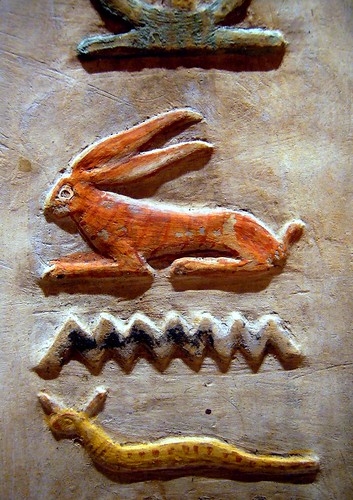
It can be difficult to talk about Egyptian mythology with certainty, because there are so many different versions of things.  In my favorite Egyptian creation myth (I'm not sure what city it is from I heard it in my archeology of Ancient Egypt class, it might be a few of them combined and some speculation) the world was created by primordial reptiles (probably the Ogdoad) that created a few of the gods and then mostly wandered off (presumably they had other primordial reptile things to do) they left behind one of their own, Apep to be the destruction of the world. I have alway liked the metaphor of that one with the world coming from a sort of uncaring chaos that presumably wandered off to go make other worlds. Apep is generally represented as an Egyptian horned viper (Cerastes cerastes) this snake was also used to represent the "F" sound to simulate the sound it made as it moved through the sand. Its association with Apep made it feared enough by the ancient Egyptians (in some places) that they would carefully sever the heads of that hieroglyph to avoid Apep's influence. It was also thought to represent Apep undamaged gave him more power. It was thought by ancient Egyptian's that every night Apep would attempt to eat Ra (in many cases there were some variants that involved other gods) and every night Ra in the sun boat and a small army of gods including set and the dead would kill him (sort of) and Apep's blood would dye the dawn pink.


Monday, January 26, 2009

White stork

Not much going on today. I'm feeling a little better from the foam fighting. Stuart and I nearly have the new game ready and I'm well over halfway through the boxes. 

Art 
Goal for the week 20hrs
Today 
sanding boxes still

Animal

Mythology
The white stork (Ciconia ciconia) in mythology often seems to be associated with a punishment. In Greek mythology Gerana an AEthiope was transformed into a stork by Hera as a punishment. Gerana as a stork is also responsible for the the first image of a stork carrying a baby as she attempted  to steal back her child Mopsus after her transformation. In a Polish story the Christian god decided to kill reptiles and amphibians by drowning them in the ocean in a sack this task was entrusted to a man that failed and opened the sack releasing the reptiles and amphibians. The Christian god punished this man by turning him into a stork and sending him to prey on these animals.  Also in a Polish myth the Christian god punished the stork for pride by removing the storks brightly colored plumage and dooming him to wander between two homes that the stork would eternally long for. The white stork has many other associations besides punishment in mythology. The stork may have been associated with a few gods such as the Norse god Hoenir one of the creators of humanity, Venus the Roman goddess of love, and the Germanic god of thunder Donar. In Bulgaria the stork is heavily involved in a spring rite, on the first of March during "Chestita Baba Marta" people give each other martenitsas (small red and white tassles) when the first stork is seen the martenitsa is thrown at the stork to bring health. In Britain the first stork seen is believed to be good luck if seen in flight, but bad luck if seen on the ground. In Germany is believed that it is tremendously good luck to have stork nest on ones house. Also from Germany was the idea that the souls of the unborn reside in watery places that storks tend to frequent, and that these soul arrive in a village with the storks when they come during their migration. This may have led to the well-known Victorian storks bringing babies myth. 

Friday, January 16, 2009

North American porcupine

art
Goal for the week 13.75 hours
Today
sand boxes
look into February Cons

Animal
photo by Enoch Ross
Mythology
The North American porcupine (Erethizon dorsatum) takes a strangely power role in many mythologies. For the Iroquois porcupine led all of the animals through the virtue of his even temper and determined the rotation of night and day. The porcupine also was the leader of all of the animals for the Tsimshian after impressing them all by biting off his own thumbs and he determined the flow of the seasons. In an Algonquin legend a porcupine summoned a snowstorm to punish to women that were stealing his quills. The moon took the form of a porcupine to lure a human bride into pursuing his valuable quills up a tree into the sky in an Arapaho story . There are also a number of stories about how the porcupine got his quills. The Menominee claim they were a punishment for his vanity and the quills now cover the porcupine's once beautiful fur. To contrast this for the Chippewa the quills were a gift to the porcupine from Nanabezho for cleverly thwarting a bear by covering himself with spiny Hawthorne branches.

Troodon part 2 Mythology

We had a significant temperature drop last night and club was dead. There were 10 people including Rick and Kristen and their SOs. I hope Stuart wasn't too bored, I danced a little more then usual not being intimidated by the people. We also saw a little bit of a John Carpenter movie about liquid Satan in a Jar I'm not entirely sure what was going on there. Stuart had observed that the movie had physics comparable to the movie "Anaconda"'s grasp on zoology. Oh also mostly for Grace, you may wish to check out "The Merry Thoughts" its creepy how much they sound like the Sisters of Mercy.

art
Goal for the week 15hrs
Today
assemble buffalo pipe
sand boxes

Animal
In researching Troodon formosus for my last snippet on the them which you can see here, I discovered that these guys had developed some pretty extensive modern mythology. The mythology mostly relates to the dinosaur men they might, had they not gone extinct, have evolved into, often called "Reptoids". Most of the mythology falls into three camps. There are some cryptozoologists that think dinosaur or reptile men may exist in remote areas such as Scrape Ore swamp, Thetis Lake, and Loveland Ohio where you get some lizardman type monsters. Then there are some ufology sorts that say reptoids evolved on a parallel earth in another dimension and occasionally visit this dimension and interact with grey aliens to some extent as some have seen them during their abductions. Then to elaborate on the ufology sorts there are some conspiracy theorists that think the reptoids can shapeshift and are infiltrating the US and UK goverments.

Friday, January 9, 2009

Sacred Scarab

I'm feeling kind of out of it. It may be the paint fumes at work.

Art
goal for the week 15hrs
Today
sand boxes (lots to go)

Animal
photo by Sarefo

Mythology
For the Ancient Greeks and the Ancient Egyptians there were only male sacred scarabs (Scarabaeus sacer) and they reproduced by themselves in the dung ball, they also carried their dung balls which to the Egyptians held a life giving potential in a manner similar to the sun crossing the sky. For the Ancient Egyptians this scarab was associated with the god Khepera (Khepri) who had a head that was a full scarab and was charged with filling the sun with life in the morning so that it could be rolled across the sky and then safely getting it into the mouth of Nut (goddess of the sky) so that it could emerge from her womb the next morning. Khepera has an odd relationship with Ra there seems to be several versions in some cases he is a form of Ra, in others he replaces him, and still in others he rides in the sun boat and assists. Khepera also played a part in the rebirth of the dead in that he became the dead body with the potential life (like the ball of dung) from which the spiritual body could emerge. During Ancient Egyptian burials a green stone scarab was added to the chest cavity of the deceased or as jewelry to act as a guardian of the heart, to help with the opening of the mouth ceremony, and help ward against false evidence being presented during the weighing of the heart. The scarab was also worked into jewelry and seals for a variety of reason sometimes a representation of the rebirth of the body, probably sometimes as a representation of Ra, other times for luck, ect. I could probably babble far longer on the various significances of the scarab in Ancient Egyptian religion and the uses of faience scarab seals but I should probably stop here.

Friday, January 2, 2009

Oarfish

Stuart and I spent yesterday planning the new game. It should be ready soon.


Animal
Sea Serpents and Nagas
It has been often said that the oarfish (Regalecus glesne) may be responsible for many of the sea serpent legends. It was suggested by Fredrick McCoy in 1878 that the oarfish was a very good candiate for the sea serpent of legend as it was a very rare strange looking fish that sailors would be very unaccustomed to seeing unlike seals and long clumps of seaweed. This is probably not a bad point there is a specific modern example of an Oarfish being mistaken for a Thai naga or a Nak. Nagas are beings with snake and sometimes human features that are often associated with deep water and fertility. If you would like more detail about what a Naga is go here. The Nak is genally depicted as a long crested serpent sometimes with 7 heads. So a long crested eel like fish is probably not a terrible match, not a serpent but it is snakelike and has a crest. On September 9, 1996 a very large oarfish was found at a navy seals base in Coronado Island and a photo was taken by Leo Smith, which featured in the Coronado Eagle in April 1997. Somehow a doctored version of this made it to Thailand with the caption "Queen of Nagas seized by American army at Mekhong River, Laos Military Base June 27, 1973 with the length of 7.80 meters. It is theorized the doctored picture was originally sold in Nong Khai possible during "Bung Fai Phya Nak" an event that occurs the on the full moon the 11 month of the luna year at the end of Pansa or Vassa, also sometimes called Buddhist lent. During this festival large soundless red fireballs rise from the Mekhong river and disapate every year and no one really knows why, the best scientific theory for a natural explaination so far is swamp gas coming from moving water or of course humans. The explation generally attributed to the festival is that the King of the Nagas/Nak creates the fireballs in honor of Buddha on this day. The photo is now somewhat commonly found with vendors at this festival and has developed it's own urban legends. One story about the photo was that the men in the photograph ate the flesh of the that Naga and then all of them died. Thus I think the theory of Oarfish being mistaken for legendary creatures is fairly valid.

Here is the Queen of the Nagas photo

Tuesday, December 30, 2008

Monito del monte

I'm thinking that this will not be an art week as I'd like to get the damage in the studio cleaned up. Though I should still get the January shows mailed off.

Animal
The Monito del monte (Dromiciop gliroides) is a small marsupial found in the mountains of Chile and Argentina mostly in Chilean bamboo forests. They are nocturnal omnivores with prehensile tails it is said that their metabolism is so fast they can double their body weight within a week. They are more closely related to Australian marsupials then American marsupials and it is thought that they are related to some marsupials that came to South America from Australia via Antarctica. The Huilliche of Chile have a malignant somewhat vampiric creature called the Colo-colo that has the body of a long mouse and the head of a rooster and will drink the saliva of sleeping people in a way that is eventually fatal it also cries like a baby. The native people of that area also call this animal a colocolo and consider it such bad luck they will burn their houses down if it is seen living in the house. I think these things may be related.

Friday, December 26, 2008

American Alligator

Not much going on today.

Animal
photo by uncleboatshoes
Mythology
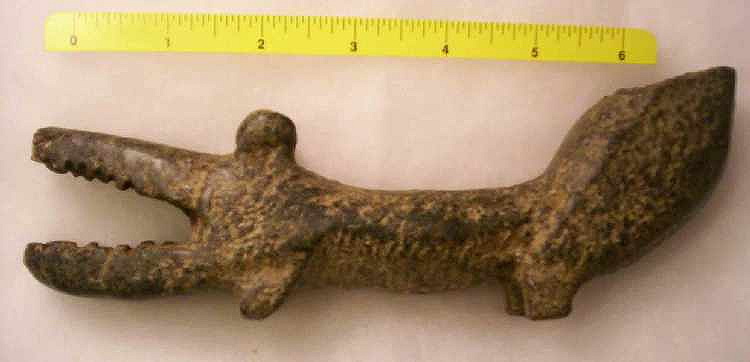
The American alligator taught the Choctaw to hunt patiently and wait for the correct deer. For the Creek, rabbit tricked the alligator into his ridged back by convincing him to sit in a fire and endure a terrible burn to prove his bravery and lack of fear of the "devil". In New York the sewers are filled giant blind albino alligators that are descended from escaped pets. The colonizing Spaniards thought a stone cut from an alligator could relieve fevers. The Ojibwa had a monster called the rugaru, part wolf and part alligator anyone who saw one became one. For the Maya, Tamcaz was an alligator that made up the milky way and his jaws led to the underworld and the alligator is featured on their calender.

Drawing of alligators from an account of William Bartam 1791

Native American alligator effigy pipe

Thursday, December 18, 2008

Blue Jay

Last night I realized that it was getting particularly close to when I was going to have to visit my relatives and that I should probably make a something to give them. I started this clip on titmouse ornament last night.

Art
goal for the week 17 hours

Today
-fix and cast skull
-finish titmouse thing for relatives

Animal

I thought I would do another mythology post this time about blue jays. For the the Hotcak the Blue Jay was named Djedjedjiniga and associated with the trickster Wakdjakag. At one point the blue jay, the fox and the chipmunk were living with the trickster and having a rough winter. The trickster dressed up as a woman creating fake bits out of elk organs and had blue jay, fox, and chipmunk hide inside of him so that he can pretend to be pregnant. They went to a successful nearby tribe and managed to get the chief's son to marry the trickster. Then the story goes on about the tribe commenting how quickly she can get pregnant eventually the trickster gives birth to all of the animals and they start making ridiculous demands that the tribe tries to fill. Eventually the trickster drops the rotten elk liver he had been using as a fake part and the whole illusion falls apart, then the tribe runs the four of them out of town. The major god of the Hotcak also punished the blue jay for his ugly nature by removing his beautiful song so that the hideous shrieking of his song would reflect his inner nature.
The Bluejay was also a very important trickster figure to the Chinook, in this culture the blue jay figure fills a role similar to Loki. Blue jay is turned into a bird after losing an archery contest with the "supernatural people". The "supernatural people" also made his song a bad omen. Blue jay at some point is able to get the "supernatural people" to turn back into piles of bones, during which he rearranges their body parts so that when they become ghosts again they have the wrong heads.