Showing posts with label cute animal. Show all posts

Sunday, July 19, 2009

Blue Tongued Skink


packing

Art
I'm not sure still need to raku fire stuff and coat the sphinx

Animal
The blue tongued skink (Tiliqua scinoides) is a 2ft skink from Australia. As their name implies they have a bright blue tongue which they use for threat displays. When threatened they will puff up their body to appear larger and stick out their alarming blue tongue. It is thought that their display may also mimic a death adder's as they are similar in coloration and share the same range. Blue tongued skinks are omnivores some have a particular fondness for snails. They give birth to live young after the eggs have developed inside their body, some give birth to more then 10 offspring at a time. They are very common in the pet trade and commonly captive bred. Most of the ones I've met tend to have good natures and they tend to be reasonably hardy.


Saturday, July 18, 2009

Bar Tailed Godwit


Lots of stress. Packing.

Art
Now that I have a nice protective layer on the sphinx divide the pieces of the mold off and put a coat on one piece
glaze rabbit and fly
raku fire rabbit and fly

Animal
The bar tailed godwit (Limosa lapponica baueri) breeds in Alaska and then winters in Australia. They complete this migration in one non-stop flight of over 6400 miles it can take them 175 hours. This is the longest non-stop flight known in any bird and they do this without feeding. Before they leave they double their body weight yet despite all the physical activity they do not arrive in Australia completely emaciated. Around the time of the flight their internal food processing organs shrink greatly in size and it is thought that this helps to balance out the new fat reserves they have just put on. The other subspecies have similarly long migrations ssp.lapponica goes from Scandinavia to southern Africa and ssp.menzbieri goes from Northern Asia to New Zealand.

Friday, July 17, 2009

Greater Glider


Lost my connection yesterday. We went to goth night and were vaguely social. Rick got a giant antique scythe that he is planning to hang on his wall.

Art
put a coat of silicone on the sphinx
glaze rabbit and soldier fly parts
raku fire rabbit and soldier fly parts

Animal
The greater glider (Petauroides volans) is a gliding possum from Australia, and it's coloration and markings show a great deal of variety. It has been observed to be able to glide up to 120 feet. They are competitors of the Koala as they too feed almost exculsively on Eucalyptus leaves.

Saturday, July 11, 2009

Crested Auklet


Art
Still carving the rabbit

Animal

The crested auklet (Aethia cristatella) nests in giant colonies numbering sometimes over 1 million birds in the Bering Sea. They are said to smell strongly like tangerines, so strongly in fact that humans can smell crested auklet colonies for miles. It is thought that the birds use the scent to find their colonies. Crested auklets eat mostly very small invertebrates such as krill and copepods.

Monday, June 29, 2009

Malagasy Rainbow Frog


I may be posted in a not very regular manner for the next month and a half. We are doing a long distance move soon and I will likely have a few periods where I have no internet connection. (It is also going to cut into the Art quite a bit). Things should get back to normal after that.

Art
work on ceramic parts of rabbit and not flower but soldier fly

Animal

The Malagasy rainbow frog (Scaphiophryne gottlebei) lives in narrow sandy canyons in the Isalo Massif area of Madagascar. They burrow in the sandy substrate much of the time and will climb the vertical rocky walls of the canyons they live in for several meters. Tadpoles of this species have a psammonektonic feeding behavior durning the day the sit along the bottom at a 45 degree angle and filter feed on the substrate then at night they swim freely feeding as well. They are critically endangered for a variety of reasons habitat destruction logging, fire, and overgrazing being the big one. There is also a great deal of concern about sapphire mining activities in their range. It has also been determined that a significant cap needs to be put on the number of individuals collected for the pet trade the Edge suggests no more then 1000 individuals per year. While they recover very well from individual predation their range is too small to sustain the level of collection that currently occurs, so it is currently very damaging. While they have not yet successfully bred and fully reared in captivity it is thought that there is reasonably good potential that they can be bred in captive conditions, it is the hoped that extremely limited collection will allow a breeding captive population to be established.

Saturday, June 27, 2009

Asian Small Clawed Otter


finished the cricket
Art
start the rabbit and flower fly

Animal

The Asian small clawed otter (Aonyx cinerea) is the smallest of the the otters. It is native to southern Asia and tend to live in small groups of about 12 individuals. They climb well, I once saw several of them at a zoo scale the chain link side of their enclosure. Their claws are very short and fingernail-like this is said to give them greater manual dexterity then most otters. It has been recorded that they have 12 different vocalizations they communicate with.

Saturday, June 20, 2009

Russian Desman


I got into a long pointless (though civil) political argument at work last night and did not get home until it was late, so this is yesterday's entry. There was a relatively intense storm last night and we had most of one of the trees fall down into the driveway. Only the tree was damaged I think it will survive the damage though. Today and tomorrow I will be mostly studying for the Net +.

art
assemble cricket and cory catfish

Animal
The Russian Desman (Desmana moschata) is an odd looking aquatic insectivore that is related to moles from southwest Russia It is mostly found along the Don, Ural, and Volga. It uses its long flexible nose as a snorkel while swimming and It's nose also contains an Elmer's organ a sensory organ found in moles. It was once hunted for it's musk glands and fur, but is currently endangered. It is the only animal that has the word Russian in it's name and was adopted by the Russian Party of Life as their mascot for a time before they merged with other parties it is also featured on a coin. One of the names of the Russian Desman in Russian is vykhukhol which might be or sound like something profane but I'm not sure what. Perhaps I can ask Greg my friend who is fluent in Russian if I think about it later.

Monday, June 15, 2009

Giant Frog-eyed Gecko

I dropped the figure with the Anubis mask and fairly throughly destroyed it. I will recreate it but I don't think I will be able to finish it before the move so I will probably have to wait until after. I started some small pieces that might turn into something.

Art
carve cory cat and cricket

Animal

The Giant Frog-eyed Gecko (Teratoscincus scincus) is an adorable burrowing desert gecko from the Middle East. It would be a poor idea to cuddle them as they have exceptionally fragile skin that can be torn quite easily and they are very nervous geckos. It's possible rough handling could partially flay them. They have some of the thinnest skin of the geckos that do not use skin loss as a defense mechanism.

Saturday, June 13, 2009

Secretary Bird

I'm starting to get worried about this silicone I ordered it hasn't come in yet. 

Art
goal for the week 5 hrs
make clay
work on the figure with the Anubis mask

Animal
The secretary bird (Sagittarius serpentarius) is a terrestrial raptor from sub-saharan Africa with long stork-like legs. As its scientific name implies it does often eat snakes and other small creatures. It hunts by grasping the small creature and beating it against the ground. It is the national emblem of Sudan and the name secretary bird came from the Europeans who felt that it looked like the bird was wearing a coat and tails with quills behind it's ears.


Friday, June 12, 2009

Goodfellow's Tree Kangaroo

not feeling well today

Art
goal for the week 6.5 hours
sick

Animal
Goodfellow's tree kangaroo (Dendrolagus goodfellowi) is an endangered tree dwelling macropod from New Guinea and Indonesia. They eat mainly silkwood leaves and have a stomach with a fermentation vat similar to that of a cow. They are one of the largest Dendrolagus tree kangaroos at about 15-22lbs. A combination of habitat destruction and overhunting are wiping them out in the wild, fortunately they are breeding well in captivity.

Wednesday, June 3, 2009

Common snakeneck turtle


Art
goal for the week 16hrs
today
work on floor tiles
make clay

Animal
The common snakeneck turtle (Chelodina longicollis) is an Australian turtle with a neck as long as the rest of it's body. It also has potent musk glands which give it another common name "the stinker" which they can spray up to 3 feet when threatened. They for some reason not uncommon as pets in Australia, perhaps they are difficult to frighten badly enough to spray.

Tuesday, June 2, 2009

Southern white faced Scops Owl

I discovered that I was out of silicone so I ordered some today.

Art
Goal for the week 18.5 hrs
make clay
make the floor tiles for the figure

Animal
The Southern white faced Scops Owl (Ptilopsis granti) comes from southern Africa. They will occasionally drive raptors out of their nests and take them over as their own. When nesting they will work cooperatively as a pair for the first two weeks the chicks are fed only by the male as the female incubates. After the first two weeks they will alternate hunting. They have also been known to fly long distances to find grass fires and then take advantage of the fact that the fire will drive small mammals into the open.

Friday, May 29, 2009

Yellow Spotted Boxfish

We had another big brown bat get in today while I was at work it was in my room. Jenn ended up catching it in a blanket on the bed. It was apparently really cute.

Art
Goal for the week 15hrs


Animal

The yellow spotted boxfish (Ostracion cubicus) is probably one of the truest examples of a boxfish being cubical. They are very geometric and they can grow to about the size of a football. They are less oddly shaped when fully mature. When frightened they can release a potent toxin that might explain their bright coloration. They are reasonably popular in the aquarium trade despite the fact they need over a 100 gallon tank, have never bred in captivity, and can kill all of your other fish if they are spooked. In 2006, Mercedes-Benz designed a car based on this fish call the bionic it too is very square and yellow.

Wednesday, May 27, 2009

feathered tree viper


Art
Goal for the week 17hrs
try to finish the sphinx

Animal


The feathered tree viper (Atheris hispida) is a small strange viper from central Africa. They have these long scales that bristle off their body in a way that one usually only sees in drawing of dragons and not so much in actual reptiles.  Like the Amazonian snail eater I mentioned a few weeks ago these also seems to specialize in soft bodied invertebrates. They tend to hang out basking on the very tops of trees. They do very poorly in captivity with a very high mortality rate even among experienced keepers.


Sunday, May 24, 2009

Coquerel's Sifaka

Art
stuff

Animal

Coquerel's Sifaka (Propithecus coquereli) is one of nine known species of sifaka all of which are found on the island of Madagascar they are very genetically distinct from other lemurs as a group. Coquerel's Sifakas are very matriarchal and even sub-adult females are dominant over males. Females have preferential access to food sources and males will wait until the group of females have moved on from a tree before moving into feed. They also have an interesting way of getting around on the ground in that they jump forward like kangaroos. In some regions of Madagascar killing and eating these sifakas is considered a fady (taboo) but I can't seem to find the reason why which is too bad I have a feeling there is a story there.

Wednesday, May 20, 2009

Grey bicher


Art
Goal for the week 17.5 hrs
Today work on sphinx

Animal
I ran into these guys for the first time while picking up crickets at a Petsmart labeled as "Dinosaur eels" and thought they were very oddly built fish with all of the spikey little fins in back. The grey bicher (Polypterus senegalus) is an African fish that is from an ancient group of fishes that are mostly cartilaginous but have some bone.  They also have rudimentary lungs and so breathe a little bit from the air as well as the water. One of their lungs stretches almost the entire length of their body. Here is an animation (towards the bottom of the page) that shows that.  The grey bicher also has very well armored scales that may be inspiring future military armor. 

Tuesday, May 19, 2009

Red spotted newt

In the network + 2009 book I've been reading they go a bit overboard with the security section. They start out perfectly reasonably with firewalls, various network set ups, and encryption and then they moved to mantraps, 8ft fences with razor wire, and guard dogs. I suppose hackers would not be expecting a guard dog in the MDF. They open the dog suddenly an angry German Shepard flies out at them. The night crew and I at work then talked about other animals what could guard and MDF. We went through the usual big cats, poisonous snakes, and crocodiles. We eventually decided that the Cassowary might be the best choice as they would first confuse and then eviscerate the intruder.  

Art
Goal for the week 17hrs
work on the sphinx.

Animal

The red spotted newt (Notophthalmus viridescens viridescens) is a mildly toxic newt that has an interesting life cycle. They start out aquatic like other amphibians, then they go through a very cute terrestrial stage where they are tiny bright red newts that disperse to other ponds, and once they find a pond they return to a fully aquatic stage as adults and loose most of their bright coloration. The red spotted newt's range some how just misses us, but they can be found in northern and southern illinois.

Sunday, May 17, 2009

Fishing cat

Stuart and I got a couple of foam swords yesterday to practice with and probably confused our neighbors.

Art
work on the sphinx

Animal 
The fishing cat (Prionailurus viverrinus) is an endangered lynx-sized cat from that ranges from Pakistan to southern Asia. They are said to be extremely ferocious for their size it was reported by (Edward?) Blyth that one he had captured had broken out of its cage into the leopard enclosure next to it and killed the leopard at least twice its size. They eat mostly fish and aquatic animals, tend to live in marshes, and are having a hard time due to habitat destruction. Their claws are very long and can not be fully retracted in the front and their feet are somewhat webbed. They are said to be able to pull their ears so closely to their heads in an effort to keep water out of them that they resemble otters.

Saturday, May 16, 2009

The Golden Toad


Art
Goal for the week-not happening 
Today 
Work on the sphinx

Animal

The coming climate change is likely to be causing quite a few extinctions, the golden toad (Bufo periglenes) has the honor of being the first extinction definitely attributable to global warming. They bred in mass in small pools in the cloud forests of Costa Rica. The effects of an effects of El NiƱo-Southern Oscillation caused these pools to dry up for several years killing all of the toad's young. They have not been seen since 1989.

Monday, May 11, 2009

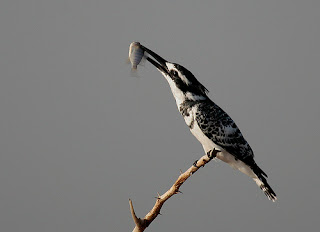
The Pied Kingfisher

Things went reasonably well with my parents. I ended up taking them to the Gordyville flea market as my mother wanted to look for antiques. We did not find any but they did have a lot of tiny puppies which went over well with her.

Art
Goal for the week 20 hrs
Today 
work on the sphinx

Animal

The pied kingfisher (Ceryle rudis) is the world's third most common kingfisher and it is native to Sub-Saharan Africa and Southern Asia. One of their closest relatives is the American green kingfisher and it is possible that they are descended from a population of them that crossed the Atlantic about a million years ago, but this is debated. Unlike other kingfishers they hunt in both fresh and salt water (the one pictured seems to be eating a cichlid).  They are the largest birds that can sustain a hover and will often hover as part of their fish hunting procedure. Three or four times a day they will cough up a pellet of undigested fish bones. It is thought that they have excellent color vision and can see into the ultraviolet range. They are also not terribly afraid of humans and tame well if fed.