Saturday, January 31, 2009

Pygmy slow loris

We had a little bit of a scare today from Kamali she seemed to have injured her leg and was not using it. We contacted the vet worried she had broken it but she started using it again normally shortly afterwards so she may have jumped off a table badly.

Art
Art goal for the week 12.75 hours
Today
sanding still

Animal
The pygmy slow loris (Nycticebus pygmaeus) is a rare prosimian primate that inhabits Vietnam, Laos, China and Cambodia. Slow lories have glands on their elbows, the sebaceous gland, that produces a substance that when mixed with saliva becomes poisonous. When threatened they tend to poison their teeth before biting. They have long canine teeth that help to deliver the poison and their smaller front teeth slope backward in such a way to conduct the saliva along the canines. They will also coat their young in poisonous saliva when they are unattended to protect them from predators. They can also emit a foul smelling substance when threatened.  This species of slow loris is a nocturnal omnivore that seems to have a preference for gums (plant juices). Their hands and feet have a muscle and blood vessel set up that allow them to maintain a ridged grip for long periods of time somewhat effortlessly. They were fairly endangered during the Vietnam war due to the tremendous habitat destruction, but they have recovered somewhat since then and there are thought to be around 70,000 of them in existence.  

Friday, January 30, 2009

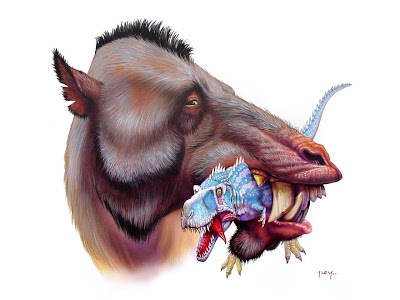
The terrible hog of Holland

I took Tempest to the vet today. That was exciting. 

Art
goal for the week 13.5 hours
Today 
sanding


Animal
The terrible hog of Holland (Dinohyus Hollandi) was a giant entelodont that not only would make a great monster in an rpg but also sounds like one of the things Hunter would have fought in the book "Neverwhere". Entelodonts were related to modern pigs and this one was very large at roughly the size of a bison they existed from the Oligocene to the Miocene in North America. It was not found in Holland and was in fact named after John Holland. The name was actually intended to be an insult to John Holland as he had a tendency to force his way to senior author of every paper so in this case the head line Dinohyus Hollandi  "World's biggest hog". The terrible hog of Holland was a likely a lot more carnivorous then modern pigs (not that modern pigs are not more carnivorous then you would think) and while still and omnivore probably ate a lot of carrion and preyed on small animals.

Thursday, January 29, 2009

Hawaiian bobtailed squid


Art
Goal for the week 15.25 hours
Today
buy more sandpaper
sand boxes

Animal 

The Hawaiian bobtailed squid (Euprymna scolopes) is a tiny squid that only grows to a little over 1 inch in length and lives in tropical coastal Pacific areas. This squid sometimes lives in incredibly shallow water only 2-4 cm deep. The Hawaiian bobtailed squid is a short lived squid completing its life cycle in only 3 to 10 months. Given its unpredictable behavior it is also thought that it is quite intelligent. This squid has a symbiotic relationship with a light producing bacteria Vibrio fischeri. The squid has a light organ in it's mantle that it purposely infects with Vibrio fischeri. It feeds the bacteria with this organ and the bacteria produce a controlled amount of light from the bottom of the squid. This light helps it to avoid creating a silhouette that would tip off predatory fish to it's presence. Interestingly the bacteria in this light organ can give off 1000 times more light then that bacteria cultured independently. This symbiotic relationship seems to be in the process of being studied reasonably heavily at this time from what I can tell based on all of the online papers. This Vibrio bacteria is a harmless light producing species, however other Vibrio bacteria are responsible for shellfish poisoning and Cholera, so the study of the mechanisms of this symbiotic relationship may also be useful for human health studies. In the process of these studies they have also worked out how to breed this squid in captivity which is quite a challenge as squid require very difficult to produce water conditions.

Wednesday, January 28, 2009

Flying gurnard

Tired today

Art 
goal for the week 15.5 hours
Today 
still sanding (yay)

Animal

The flying gurnard (Dactylopterus volitans) ranges over tropical and temperate coastal waters of the Atlantic. It is in the same order as scorpionfish, but is itself non-venomous. They walk along the ocean floor and use their huge fins to find invertebrates. Like gurnards they have a drumming muscle that can be beaten against their two lobed swim bladder to produce sounds. There are some scientists in Ghana that have figured out how to make non-bovine gelatin from this fish. It seems they wanted to do this because this fish is a frequently wasted by-catch of the Ghana fishing industry. I have to admit upon first seeing this paper I was confused as to why they would want to make gelatin out of an uncommon wild caught fish rather then the byproducts of a widely captive raised mammal.

A video of a flying gurnard swimming (I think this was the right species but it may also be an oriental flying gurnard)

Tuesday, January 27, 2009

Marbled newt

Yesterday, I played with my labels a bit on this blog. I'm hoping I can make searching for animals on it a little bit more friendly. I'm still playing with them at this point. Oh I should probably note for the "weird bug" label I'm going for land based invertebrates I would be pleased to find under a rock rather then Hemipetra (not that there are not impressively weird Hemipetra) or even really Arthropods. I'd also take the "cute animal" label with care I'm told I'm not a good judge of this. If there is a manner of sorting you would like to see let me know.

Art
Goal for the week 17.75 hours
Today
still sanding

Animal
The marbled newt (Triturus marmoratus) is found throughout much of France and Spain. The females are much larger then the males, but the males grow an impressive crest during the mating season. Newts have an amazing ability to regenerate limbs and sometimes eyes and organs. They also seem to be some what vulnerable to the conditions that cause frogs to grow extra legs. In frogs this is caused by Ribeiroia ondatrae, a trematode parasite, it is found in American newts and may be found in this newt as well. I have a found a video I will be putting at the bottom showing one of these newts with seven legs. According to a study by Diego-Rasilla and Luengo in 2002 marbled newts find their breeding pools by visually orienting themselves based on the position of stars. The study put them under  the condition of a misleading magnetic field and in several night sky conditions and they were found to be able to orient themselves when stars were clearly visible. 


Monday, January 26, 2009

White stork

Not much going on today. I'm feeling a little better from the foam fighting. Stuart and I nearly have the new game ready and I'm well over halfway through the boxes. 

Art 
Goal for the week 20hrs
Today 
sanding boxes still

Animal

Mythology
The white stork (Ciconia ciconia) in mythology often seems to be associated with a punishment. In Greek mythology Gerana an AEthiope was transformed into a stork by Hera as a punishment. Gerana as a stork is also responsible for the the first image of a stork carrying a baby as she attempted  to steal back her child Mopsus after her transformation. In a Polish story the Christian god decided to kill reptiles and amphibians by drowning them in the ocean in a sack this task was entrusted to a man that failed and opened the sack releasing the reptiles and amphibians. The Christian god punished this man by turning him into a stork and sending him to prey on these animals.  Also in a Polish myth the Christian god punished the stork for pride by removing the storks brightly colored plumage and dooming him to wander between two homes that the stork would eternally long for. The white stork has many other associations besides punishment in mythology. The stork may have been associated with a few gods such as the Norse god Hoenir one of the creators of humanity, Venus the Roman goddess of love, and the Germanic god of thunder Donar. In Bulgaria the stork is heavily involved in a spring rite, on the first of March during "Chestita Baba Marta" people give each other martenitsas (small red and white tassles) when the first stork is seen the martenitsa is thrown at the stork to bring health. In Britain the first stork seen is believed to be good luck if seen in flight, but bad luck if seen on the ground. In Germany is believed that it is tremendously good luck to have stork nest on ones house. Also from Germany was the idea that the souls of the unborn reside in watery places that storks tend to frequent, and that these soul arrive in a village with the storks when they come during their migration. This may have led to the well-known Victorian storks bringing babies myth. 

Sunday, January 25, 2009

Black Thighed Falconet

Stuart and I tried foam fighting yesterday morning. I was not expecting to be quite as sore afterwards (it is as though lots of people were hitting me very hard with foam covered sticks). Incidentally, I'm not very good at foam fighting so it was mostly being beaten with sticks.

art
sanding boxes (still sanding boxes)

Animal
One of the world's smallest birds of prey is the black thighed falconet (Mircrohierax fringillarius) it is only about 6 inches long and lives in Malaysia, Thailand, Singapore, and Indonesia. They tend to be found in forest from low elevations to up to 1500m. The Mircrohierax falconets have been found to be most related to the African pygmy falcon and very distinct from other falconet genuses. They eat mostly large insects like dragonflies and mantids. On occasion they will also take small birds such as munias and sunbirds which are only slightly smaller then the falconets. It has been observed that they will occasionally hunt cooperatively to capture large insects. They tend to nest in tree hollows in a cooperative pair. Chicks can sometimes be seen in the hollows yawning for long periods of time in an effort strengthen their jaw muscles.