Wednesday, December 31, 2008

Green Basilisk

My roommates and I actually went out last night, we tried to go to a piano/sports/fondue bar in desolate mostly empty mall for a surreal experience, but it was actually quite crowded. They had some sort of special lounge singer event. We ended up going to a nearby bar and playing "Lunch Money" for a few hours.

In South and Central America there is a mid-sized lizard that can run on the water's surface, this would be the green basilisk (Basiliscus plumifrons). They run on the water by churning their legs quickly and creating a pocket of air. They are also excellent swimmers and can remain underwater for around a half an hour. The males tend to have much more impressive crests then the females these crests are actually supported bony projections. They are not uncommon as pets though they are not known to be extremely friendly and have difficult care requirements. I remember we got one in when I worked at the pet store and we had a bit of difficulty getting the humidity right and I think he bit me, I've been bitten by so many lizards it is hard to keep track. I think he was somewhere between being bitten by a spiny iguana and a fairly pissed off leopard gecko. I'm generally fairly nice to reptiles and try not to scare them but between working at the vet and receiving new lizards in at the pet store I've run into a lot of angry reptiles. I've yet to gain any lizard-based super powers from any of them disappointingly.

Basilisk runs on top of the water video

Nice picture of a basilisk running on the water

Tuesday, December 30, 2008

Snipe

I was relieved to find out most of my wooden boxes in the studio had not been destroyed by the flood. I have a half day today at work and they take the garbage tomorrow so I should be able to get some of the wet cardboard and cured plaster and cement out. I had to store the plaster on the floor. I wonder how many days I should wait before I try the power tools that got wet.

Animal
photo by omarun

It occurs to me that a lot of people are not aware that snipes are a real animal. The common snipe (Gallinago gallinago) is an odd looking shorebird that ranges from North America to Europe. I'm not sure why one would want to catch one in a bag during a camping trip. They are considered game birds and apparently very difficult for hunters to shoot as they fly very quickly and in an erratic zig zag pattern. Hunters that hunt for snipe generally need to be a very accurate long range shot to kill them hence the term "sniper". The term "sniper" became a military term in 1824 when it was generically used to refer to a "sharpshooter". As far as the snipe itself they typically live in marshes and eat small invertebrates they dredge up with their specialized bill. They male makes a strange sound with it's feathers during a mating display that has also earn the bird the nickname "the sky goat". They have interesting parental care the clutch is generally 4 egg after they have hatched the male leaves with two chicks and the female cares for the other two the two families generally do not reunite.

Monito del monte

I'm thinking that this will not be an art week as I'd like to get the damage in the studio cleaned up. Though I should still get the January shows mailed off.

Animal
The Monito del monte (Dromiciop gliroides) is a small marsupial found in the mountains of Chile and Argentina mostly in Chilean bamboo forests. They are nocturnal omnivores with prehensile tails it is said that their metabolism is so fast they can double their body weight within a week. They are more closely related to Australian marsupials then American marsupials and it is thought that they are related to some marsupials that came to South America from Australia via Antarctica. The Huilliche of Chile have a malignant somewhat vampiric creature called the Colo-colo that has the body of a long mouse and the head of a rooster and will drink the saliva of sleeping people in a way that is eventually fatal it also cries like a baby. The native people of that area also call this animal a colocolo and consider it such bad luck they will burn their houses down if it is seen living in the house. I think these things may be related.

Monday, December 29, 2008

Troodon

Still working on the basement.

Animal
Troodon formosus have always been my some of my favorite dinosaurs. They are very late small maniraptors from North America. They were probably nocturnal omnivores and seem to have had a very long run before their extinction, as they are found from Montana to Alaska over a span of millions of years. Troodon had binocular vision and probably excellent depth perception it also had the largest brain among dinosaurs relative to its body mass. Like velocoraptors they also had retractable toe claws. Because this dinosaur had grasping hands, a large brain and binocular vision in 1982 paleontologist Dale Russell toyed with the idea had they not gone extinct they may have become sapient. They created a model of a "Dinosauroid" that is displayed in the National Museum of Nature in Canada. Other paleontologists felt this was too human-like and have developed more bird-like drawings of a "Dinosauroid". Some cryptozoologists also seem to like the idea and are now looking for dinosaur men. I may have to do a mythology article on these guys later.

Sunday, December 28, 2008

Bell bearer leafhopper

I had to work today to make up for the day off Friday. We started cleaning out the flood damage having finally gotten the water out of the basement. I have not yet found a dehumidifier but I think that would help a lot.

Animal

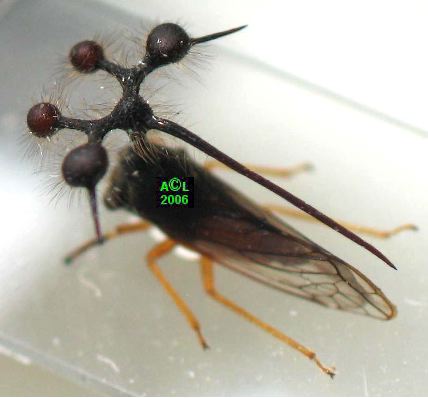
The Bell bearer leafhopper (Bocydium globulare) probably has the strangest thorax among insects. It appears to be a leafhopper carrying a 1950's modernist sculpture on it's back. This 4mm leaf hopper is from South America (most of the pictures I found were taken in Brazil) and is a member of the Membracidae family which are known for their strange shapes. Many members of the Membracidae family would make lovely organic modernist pieces. The growth on its thorax breaks easily and might be carried off instead of the leafhopper by a predator. It is also theorized that the growth on this leafhopper's thorax may mimic an insect's head from the front.

Here is a photo of the Bell bearer

Saturday, December 27, 2008

Four-eyed fish

I got home from my relatives to find that my basement/studio had flooded. So, far I think I've lost the welder and a few small power tools, fortunately the kiln was not damaged. We are currently waiting for the pump. If I'm very lucky the welder will work after it dries.

Animal
rerun from live journal
The four-eyed fish (anableps anableps) is an unusual South American live bearer with two pupils in each eye. Both of its pupils are connected to the same iris but the thickness of their lens vary quite a bit. One pupil is well adapted to see above the surface of the water and the other below the surface. The fish can process both inputs at once. Four-eyed fish spend most of their time at the surface of the water and tend to hang out in schools. They are not unheard of as aquarium fish and tend to do well with un-aggressive brackish species.

Friday, December 26, 2008

American Alligator

Not much going on today.

Animal
photo by uncleboatshoes
Mythology
The American alligator taught the Choctaw to hunt patiently and wait for the correct deer. For the Creek, rabbit tricked the alligator into his ridged back by convincing him to sit in a fire and endure a terrible burn to prove his bravery and lack of fear of the "devil". In New York the sewers are filled giant blind albino alligators that are descended from escaped pets. The colonizing Spaniards thought a stone cut from an alligator could relieve fevers. The Ojibwa had a monster called the rugaru, part wolf and part alligator anyone who saw one became one. For the Maya, Tamcaz was an alligator that made up the milky way and his jaws led to the underworld and the alligator is featured on their calender.

Drawing of alligators from an account of William Bartam 1791

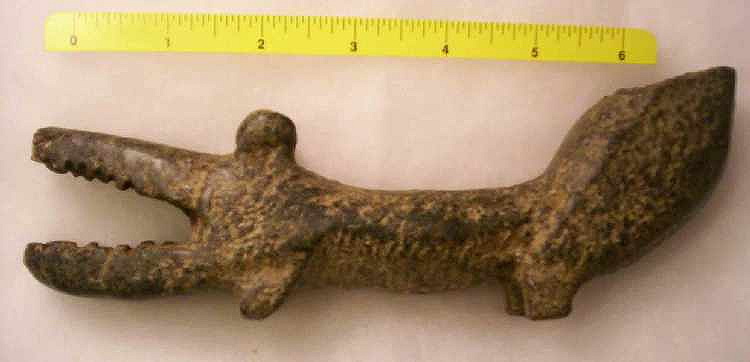
Native American alligator effigy pipe